Introduction
At a Glance
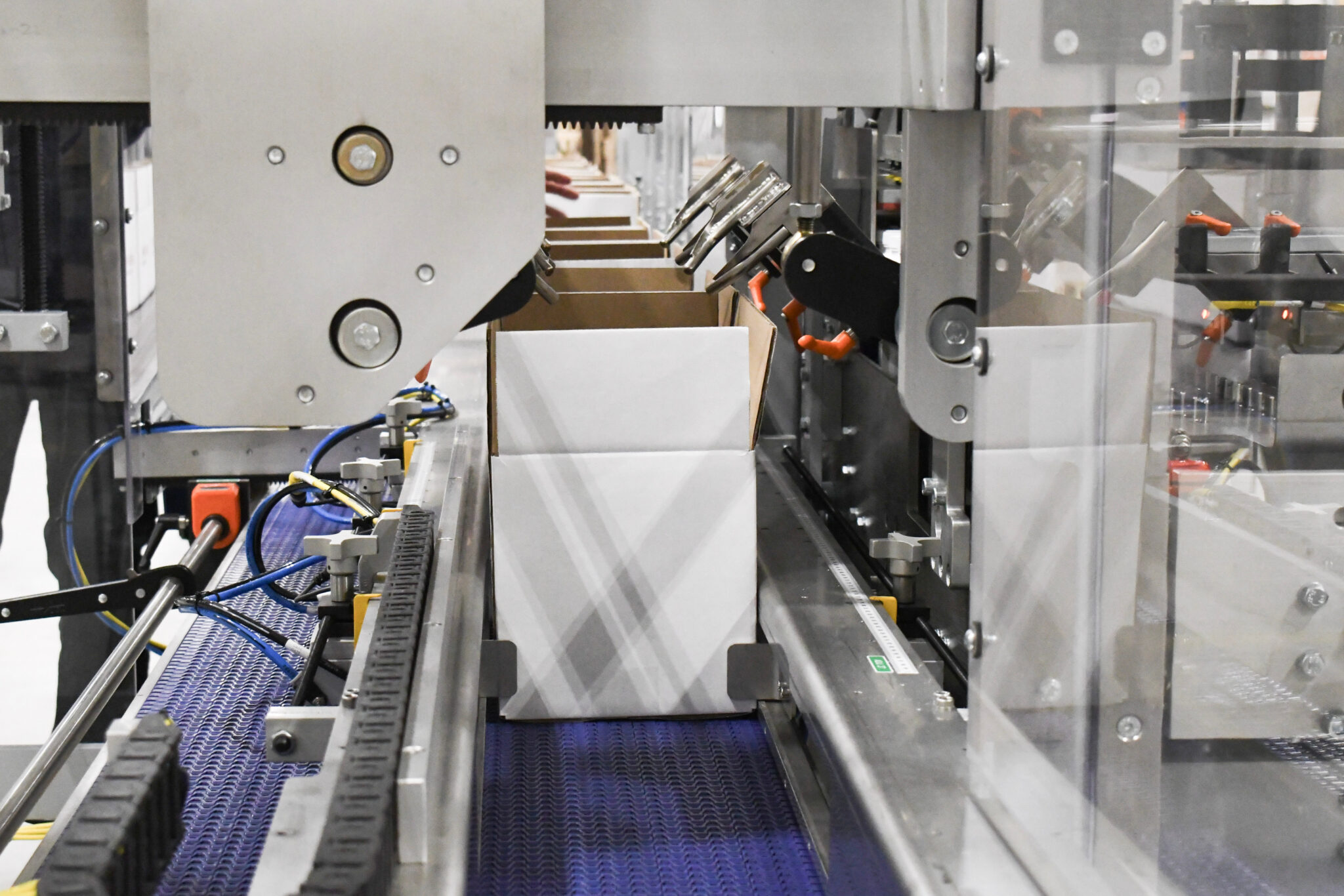
Case loaders are the machine in your secondary packaging line that actually handles and loads the product into a case. That’s why it’s so important that you choose the case loading methods that meet the needs of your product.
There are three main methods:
- Drop Packing – Drops product into the case from above; it’s rough and uncontrolled, but fast and low cost
- Tamp-and-Load – Collates product, and then tamps product down, before pushing it into the case; it’s controlled and fast, but more mechanically complex
- Robotic Pick-and-Place – An articulated robot arm, with end-of-arm tooling (EOAT), picks and places product by a pre-programmed pattern; it’s flexible and gentle, but slightly slower and higher cost
The right case loading method should be dictated by your product, speed, SKU-mix, and capital budget. And for challenging decisions, a good vendor can go a long way.
Case loaders do exactly as their name suggests: they load cases. But making case loader decisions is (and should be) much more complex. Case loaders are the machine that actually handles your product.
There are three main case loading methods, and the right choice is made by the standard operational factors of speed, cost, and variability – but it’s also dictated by the needs of your product. The right case loading method is the one that safely handles your product and accommodates your expectations.
In this article, we’ll cover:
- Why case loaders are key to product quality
- The three main case loading methods
- Strengths, limitations, and best fits for each method
- The four factors that should inform your decision
Case Loaders – Why They’re Key to Product Quality
A case loader plays a straightforward role – I mean, it’s in the name. It sits between the case erector and the case sealer in a secondary packaging line. The erector opens cases, the loader fills them, and the sealer closes them. That’s the simple gist of it.


But their straightforward understanding should not translate into low-priority equipment decisions. Case loaders are crucial to packaging lines. Not only are they the machine that does the packing, but they’re also the machine that directly handles product.
Product orientating, grouping, and handling are all major factors at this station. Unlike erectors and sealers, they’re not just picking and sealing cardboard boxes; they’re loading products like glass bottles, electronics, squishable foods, and flexible bags.
Make an Informed Case Loading Decision
Choosing the right case loading method is more than asking whether you want traditional or robotic automation. It requires evaluating your product’s needs, exploring loading methods, and selecting the choice that will offer the most operational benefits while still protecting the product.
Case loading method is really a question of product quality – what your product demands and ultimately, how you’re going to deliver.
What Different Case Loading Methods Are There?
There are three main case loading methods. And each carries its own strengths and limitations. Specifics differ depending on manufacturer, but these three types are consistent across the market:
1
Drop Packing
Drop packing operates just like it sounds – it collates product above the case and drops it in, letting gravity do the work. Sometimes funnels or guide chutes are used to preserve the grouping.
-
Strengths
Drop packing is mechanically simple, fast, and low-cost. There are fewer moving parts to maintain, and it handles loose or bagged product well.
-
Limits
Drop packing is the least gentle method – product literally falls. Orientation and control factors are also limited to the capabilities of the chute geometry.
Best Fit: It works best for stable products that tolerate rough handling. It’s also great for higher speeds. Bags, pouches, and rigid containers are formats we often see using drop packing.
2
Tamp-and-Load
After collating product, the mechanism tamps down. This holds product steady, while a loading or sweeping mechanism pushes it into the case. It’s a controlled and recipe-driven motion, so pack pattern and product orientation are consistent.
-
Strengths
Tamp-and-load offers control over orientation and placement – making it a good choice for grouped or patterned lines. It also ensures gentler handling than drop packing. And it still works well for moderate to high-speed lines.
-
Limits
Tamp-and-load is more mechanically complex than drop packing. Because of this, changeovers typically involve change parts and/or recipe adjustments – adding to time and complexity.
Best Fit: It works well for products that ask for a defined orientation or specific grouping. And it can still bring real line speed, making it a typical choice for many packaging lines.
3
Robotic Pick-and-Place
With an articulated robot fitted with end-of-arm tooling (EOAT), this method picks product and sets it into a case in a pre-programmed pattern. It consolidates the separate mechanics of tamp-and-load into a single, programmable robot.
-
Strengths
Robotic pick-and-place is the most flexible method. Pattern and SKU changes are largely done by software – mixed product lines and complex retail-ready arrangements are made easy. Changeovers are fast, and handling is precise and gentle.
-
Limits
Robotic pick-and-place usually sports the highest capital cost. Speed is typically slower than tamp-and-load, unless you add multi-pick tooling or multiple robotic arms. It also carries a unique maintenance profile that requires a specific skillset.
Best Fit: It is optimal for high SKU-mixes and frequent pattern changeovers. It’s a good choice for fragile or precisely-oriented product. In lines where flexibility and fragility merit, the investment is justified.
Which Case Loading Method Is Right for My Line?
You may already have a preference of one method over another, but method choice should be made on more than preference alone. It should be informed by four factors:
- Product — Consider what sort of handling your product demands, and also factor in what orientation and placement expectations you have.
- Speed — Highest speeds favor drop-load or tamp-and-load, but robotic solutions tend to be more limited.
- SKU-Mix and Pattern Variability — Understand how many SKUs and pack patterns you want to run on this machine, and then consider how much mechanical complexity you can handle.
- Capital Profile — Drop packing is lowest cost, tamp-and-load sits in the middle, and robotic is the highest upfront, but don’t forget to account for total cost of ownership (TCO) and return on investment (ROI).
Our summaries only give you a taste of how these factors can weigh into your decision. The point is that loading method should be justified by your product, your priorities, and your line.
Method
Best Fit
Key Strengths
Key Limitations
Drop Packing
Autopopulated Label (Mobile Only)
- Drop-tolerant product
- High speeds
- Limited budget
Autopopulated Label (Mobile Only)
Fast and low-cost
Autopopulated Label (Mobile Only)
Uncontrolled and rough
Tamp-and-Load
Autopopulated Label (Mobile Only)
- Oriented/grouped product
- Moderate to high speeds
Autopopulated Label (Mobile Only)
Controlled and fast
Autopopulated Label (Mobile Only)
Mechanically complex
Robotic Pick-and-Place
Autopopulated Label (Mobile Only)
- Variable SKU-mixes
- Fragile product
- Precise patterns
Autopopulated Label (Mobile Only)
Flexible and gentle
Autopopulated Label (Mobile Only)
Slower speed and higher capital
Case Loading Method – Making the Confident Choice
When considering case loading methods, product and operational factors make the decision. The better you know your line, and the priorities that rule it, the more confident you’ll be when deciding on the right loading method.
However, if you are finding it challenging to select the best fit for your line, consult a vendor to get their opinion. Vendors have seen many different products, different needs, and different expectations. Between customer experience and machine knowledge, a good vendor can make a big difference when navigating equipment decisions.
Are You Looking for a Case Loader Vendor?
Give INSITE a call. Our specialists will walk you through our case loader solution, answer your questions, and help you evaluate which loading method is the right fit for you.