Introduction
At a Glance
Case erector cost starts with the machine designer’s intent. What does the machine need to do? What case dimensions should it accommodate? How much reliance should be placed on the machine vs. the operator. After that, the specs and functions are built … as well as the cost drivers.
Here are the 11 Key Drivers of Case Erector Cost:
- Speed and Throughput Capability
- A Theory of Operation for Simplicity
- Base Machine Capability vs. Optional Add-Ons
- Case Range and Changeover Architecture
- Case Opening, Folding, and Squaring Technology
- Tape vs. Glue Systems
- Servo-Driven vs. Pneumatic Architectures
- Magazine Design and Feeding Strategy
- Controls, HMI, and Diagnostic Depth
- Guarding and Compliance
- Built for Durability in Real Conditions
If you’ve started out on your buying journey, and noticed that machines which “erect cases” differ widely in price – sometimes by two or three times – you’re not alone. This frustrating reality buyers face is not just brand markup; it’s a range that reflects an erector’s design, components, and performance expectations.
This article is written for the buyers who have moved beyond the decision, “should we automate?” and are now faced with a daunting market. Our goal is that when you see a case erector quote, you’ll feel confident to understand its price makeup and ask the questions that will clarify your decision.
In other terms: the goal is that you will understand what you’re actually paying for, and why machines that look similar on paper are not equivalent in reality.
In this article, we’ll cover:
- What sets the foundation for automation price
- The 11 key drivers of case erector cost
- Typical price ranges for fully automated case erectors
- How cost differences reflect shifted risk
The Foundation Is Set with Design Intent, Not Spec Sheet Details
It’s important to start out with a shared understanding. Before any details exist on the spec sheet or features list, pricing begins with the intention of the designers. They settle on:
- How fast the erector must run sustainably
- How often the erector will change formats
- How variable the corrugate will be
- How much operators or maintenance should intervene
- How tightly downstream equipment depends on case quality
Two machines may look similar from specs alone, but sport very different performances on the plant floor. This is because their differences start with design intent.
Pro Tip
How fast a case erector can run sustainably, is often less than what is called out on the machine’s label. Sometimes what the label reads is specific only to one or two case formats or styles – ask your vendor for what their machine can run with your actual material and sustainably. In some situations, a lower speed can mean less productivity and ROI.
The 11 Key Drivers of Case Erector Price
To understand what (and how) certain factors can raise the foundational cost of a case erector, we’ve identified these 11 key price drivers below. If you prefer a quick rundown, you can also check out this quick overview.
1. Speed and Throughput Capability
In most automation, throughput is the single greatest driver of price – and it’s no different with case erectors. But perhaps it isn’t what most buyers assume.
A machine that runs fast isn’t just doing the same processes at faster speeds. A high-throughput machine requires:
- Stiffer Frames – to resist vibration
- Tighter Timing – between forming, folding, and sealing
- More Precise Motion Controls – to maintain squareness
- Greater Tolerance – for inconsistent corrugate at high speed
Slower automation – built for ~10-15 cases per minute (CPM) – can often achieve high speeds from time to time. But machines designed for high-speed automation, are made to hold speed continuously: across shifts, operators, and material variations.
Key Takeaway
You’re not really paying for “peak speed;” you’re paying for repeatability under stress.
2. A Theory of Operation for Simplicity
Any vendor can build a case erector by adding components one on top of the other. Rather than designing with purpose, they solve problems by adding flights, stops, cylinders, sensors, and handoffs, so each machine function works in isolation.
It’s much harder to design a capable, integrated machine, with great simplicity. A good original equipment manufacturer (OEM) burdens themselves to reduce complexity, so that your machine looks like:
- Minimal stages, flights, and mechanical handoffs
- Positive case control throughout the entire forming sequence
- Chains replaced with coordinated servo motion or robotics
This approach uses fewer total components, yet each component holds greater capability.
Key Takeaway
Price is more than technological quality; it’s a reflection of the effort that’s gone in to support a cleaner and simpler outcome.
3. Base Machine Capability vs. Optional Add-Ons
An often-overlooked driver of price is what’s included as part of the base machine, versus what’s offered as an “add-on” for additional cost.
Some machines are priced lower on the quote, because their base model is intentionally minimal. The machine erects cases, but relies on optional add-ons to achieve the performance, safety, and usability that most buyers assume are standard. This includes things like:
- UL-listed electrical components and panels
- HMI-based recipe creation and management
- Safety architecture (like Category 3)
- Automatic case squaring
- Diagnostics, fault history, and guided troubleshooting
This leads to a machine that looks cost-effective on the quote, but falls short where more expensive machines count. Sometimes it pays to spend more upfront, for the machine that has all of the features you consider necessary for a production-ready system.
Key Takeaway
The features that become optional add-ons, are not the essential functions, but the functions that make the machine reliable, repeatable, and safe.
4. Case Range and Changeover Architecture
Accommodating more case sizes and formats may increase cost, but the SKU-mix factor that you’ll really want to pay attention to is how the machine handles changeovers. That price factor may matter more in the long-run than how wide a case range your machine can handle.
Price increases with changeover factors like:
- Additional adjustment points
- Automated positioning
- Feedback devices for repeatability
- Software for recipe management
When changeover factors increase overall price, it becomes a question of what provides your operation with the most value. Manual and tool-less systems rely on operator consistency when changing over. Servo-driven, recipe-based systems manage changeovers through control architecture and validated motion profiles.
Key Takeaway
Deciding between machines with different prices (due to changeover capabilities) is really a choice in flexibility. In case size and format changeovers, will the capability live in your operator or your machine?
5. Case Opening, Folding, and Squaring Technology
One of the most underappreciated pricing drivers in case erectors is (oddly enough) how the machine actually erects cases! And the quality with which the machine does so.
When the quality honestly backs up the cost, pricier machines typically invest in:
- Positive Case Opening – with vacuums or mechanical fingers
- Controlled Minor Flap Tucking – the shorter bottom flaps are folded precisely
- Sequenced Major Flap Forming – the longer flaps are folded properly, after the minor flaps
- Compression or Squaring Sections – that lock in a solid geometry before sealing
These systems require more axes of motion, more sensors, more rigid structures, and tighter sync across functions. And they cost more, but they can justify their price through the stability and the downstream performance they enable.
Key Takeaway
Poorly squared cases rarely fail at the erector – they fail downstream, where correction is slower and more disruptive.
6. Tape vs. Glue Systems
Case sealing methods do differ in price of consumables, but they make a bigger difference in the complexity of their integration into the machine.
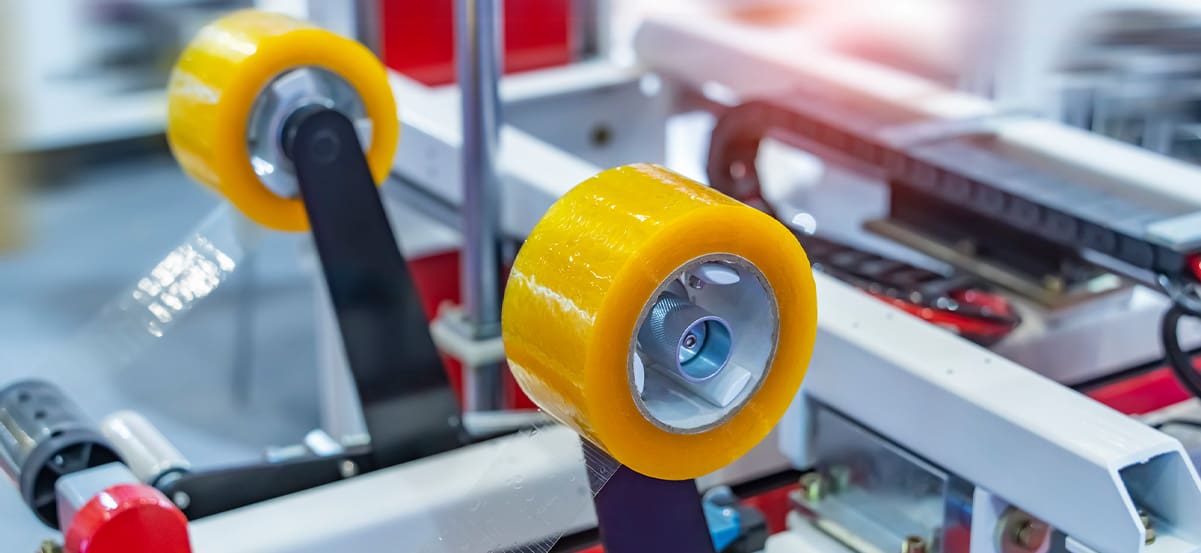
Generally, tape systems are simpler, both in mechanics and part count. They’re also faster to commission, but they may be more demanding on your resources at high speeds. Glue systems, particularly the more baseline hot melt systems, will add:
- Melters, hoses, and applicators
- Pattern control logic
- Temperature control and safety circuits
- Additional failure modes, that are remedied through engineering
But the value of glue systems comes in when you have less disruption at high speeds, and a generally better seal. More advanced glue systems will increase cost further, due to controls integration and validation – so the more advanced you go, the more you’ll want your throughput to back up the decision.
Key Takeaway
The tape vs. glue decision is usually made when technology, throughput, and hassle merit – not by preference alone
7. Servo-Driven vs. Pneumatic Architectures
A real value-weighed decision is your case erector’s motion architecture. It has a very direct and material impact on your machine’s overall price.
The main argument is pneumatic-driven – motion via compressed air – or servo-driven – motion via electrical solutions. Here are how the two compare:
Pneumatic:
- Lower upfront cost
- Simpler controls
- Greater wear-down and variability
- More dependence on air and pressure conditions
Servo:
- Additional motors, drives, cabling, and software
- Longer commissioning time
- Allow programmable motion profiles
- Reduce mechanical wear parts
Servo-driven systems offer the elimination of compressed air entirely, but shift the complexity into controls and diagnostics. So, if you’re going to splurge for servos, make sure you find an OEM who handles controls and diagnostics well.
Key Takeaway
Think less about the physical components you’re buying. Think more about whether the price is fair, given where complexity and dependence are shifted.
8. Magazine Design and Feeding Strategy
The magazine – storage on a case erector for the flat, knockdown (KD) case blanks – does influence overall price. This influence is due to its design on the following factors:
-
Magazine capacity as it relates to overall footprint
-
Type of changeover adjustments (e.g. tool-less)
-
Ergonomics for reloading (e.g. lower magazine)
Simple, lower-cost magazines rely on frequent operator interaction. Higher-cost, automated magazines reduce operator intervention, but add structure, controls, and safety considerations.
The decision may be based on cost, but it may also be influenced by the structure of your operation – are you already planning a line that’s integrated with manual operations? If so, it might be an easy decision to go with the lower-cost magazine solution.
Key Takeaway
Reduced operator touchpoints will always come with mechanical and controls costs. It is almost always a decision that weighs value with cost.
9. Controls, HMI, and Diagnostic Depth
Cost drivers in controls systems are usually engineering labor, rather than hardware. This is because the more advanced the controls systems are, the more electrical assembly and programming are required on the OEM’s side.
A basic system will provide some fault messaging, data tracking, and reactive troubleshooting. It is all very limited in scale, but enough to get some benefit from the electrical programming. A more advanced system adds:
-
Recipe-based and/or parameterized operation
-
Human-machine interface (HMI) visual diagnostics
-
Fault history and trend analysis
-
Predictive maintenance logic
-
Multi-language HMIs
Like many other cost drivers, the decision depends on what your operation looks like. Ask yourself, what machine capabilities are worth their value for you, and which are worth passing on.
Key Takeaway
Controls features don’t make the machine faster, but they can promote uptime, and provide simpler solutions when problems arise.
10. Guarding and Compliance
Safety measures are easy to list as high-priority for your operation, but may prove harder when you’re faced with a cost increase because of them. Safety-based price increases tend to occur with:
-
Safety-focused programmable logic controllers (PLCs)
-
Light curtains and interlocks (machine stops with sensing)
-
Safe or reduced-speed access modes
-
Validation and documentation efforts
These systems are more expensive because they’re just simply more complex. They include sensors, guarding, controls, and compliance efforts, which can be much like health insurance – money “pockets” that can feel useless, until they prevent a real accident.
Key Takeaway
What distinguishes sophisticated safety systems, is that they support safety intervention, without a full machine shutdown. Their price directly connects with machine uptime.
11. Built for Durability in Real Conditions
Machines live in rigorous environments. Depending on your product lines, environmental conditions can be extremely hot or cold, humid or dry, heavy or light. And good machines are built for durability in real working conditions.
Their builds show up differently through:
-
Heavier frames
-
Sealed bearings and electronics
-
Climate-controlled electrical enclosures
-
Corrosion or washdown-resistant materials
This can prove useful if you’re running food, beverage, or personal goods that require strict sanitation or environmental measures. They can also prove useful when you want to continue running on this erector for years to come.
Key Takeaway
If you make the wrong durability decisions upfront, you have to incur the expensive retrofits later.

Typical Price Range Estimates
For a case erector alone – meaning, before installation, integration, or system costs – price ranges look something like this:
Entry-Level, Fully Automated Case Erector: ~$35k-$60k
Mid-Range, Fully Automated Case Erector – With Robust Controls and Forming: ~$60k-$120k
High-Speed or Highly-Specialized Case Erector Systems: ~$150k-$250k
You’ll notice that each of these tiers spans a wide range. Remember what we said in the beginning: price differences are dependent on functionality and designer intent. The specific price of your case erector will be dependent on your OEM’s rates and your operational details.
Factors like customization level, regional build standards, and controls philosophy, also underlie these costs. But what’s more important than exact pricing is the knowledge of what the price is reflecting – that’s where the control lies.
The Heart of Pricing: Weighing Value and Cost
Fully automated case erectors cost more, not only because of the spec details you see on the quote, but also because of the designer’s intent that they started with, and how they shift risk.
Higher-priced systems tend to move risk…
Away from:
- Operators making perfect adjustments
- Maintenance reacting to wear and variability
- Downstream equipment compensating for poor case geometry
And into:
- Engineering
- Controls architecture
- Structural rigidity
- Validated motion and safety systems
Lower-priced machines can absolutely work, but they tend to put more assumption on things going right, and they rely more on human intervention. They may be a cost-effective decision if you are integrating automation into a manual line, constrained on budget, or using a lower-priced machine as a stepping-stone.
Once you see pricing as the culmination of layers of effort, intention, and risk-shifts, the question stops being, “Why is this machine so expensive?” and becomes, “What drivers are worth their cost?” and, “What will prove most cost-effective for our operation?”
Looking for an OEM with Simplicity You Can Trust?
Schedule a discovery call with INSITE. Automation doesn’t have to be complicated or all-or-nothing. Learn more about INSITE’s straightforward design and modular approach, today.