Introduction
At a Glance
It’s nearly impossible to have a clear understanding of your consumables’ costs. However, there are some simple system improvements to make, that can lead to real savings:
- Find out if you’re discarding 10-15% of every tape roll, to avoid breakage
- Don’t just use a thicker glue stream; adjust temperature, timing, and pattern
- Check your materials contract and decision-making process to understand your paths for optimization
- Track compressed air as a consumable – measured in cents per 1,000 cubic feet
- Keep asking questions about your processes to see where your costs may be hiding
Rather than purchasing a new machine and dealing with the same problems, improve the systems you already have in place. Oftentimes there’s more savings waiting to be found.
Every operation keeps tape or glue as a line item in their monthly budget. But if you’re paying one thing for rolls of tape, to your supplier, and seeing another number on your records – you may be asking, “Where are my consumables’ costs coming from?”
Unfortunately, the answer isn’t simple. And honestly, no one can cleanly track their consumption costs. That’s just the reality of packaging lines. However, you can cut costs, keep clean records, and form new processes.
In this article, we’ll cover:
- Find out if you’re discarding 10-15% of every tape roll, to avoid breakage
- Risks and long-term savings for glue equipment
- Compressed air as the consumable not tracked
- Contracts and decisions that lock your materials
- Six questions to evaluate your consumables costs
Where Do My Consumables’ Costs Come From?
Unfortunately, we can’t give you an exact answer in an article. But we can highlight some common consumption cost drivers, and what avenues exist for potential savings.
What Is Driving My Tape Consumption Costs?
Tape consumption tracks closely with case length. The length of all the cases that go through your erector or sealer directly ties to the length of tape used. Longer cases need more tape, shorter need less, and there’s no way around that consumption cost.
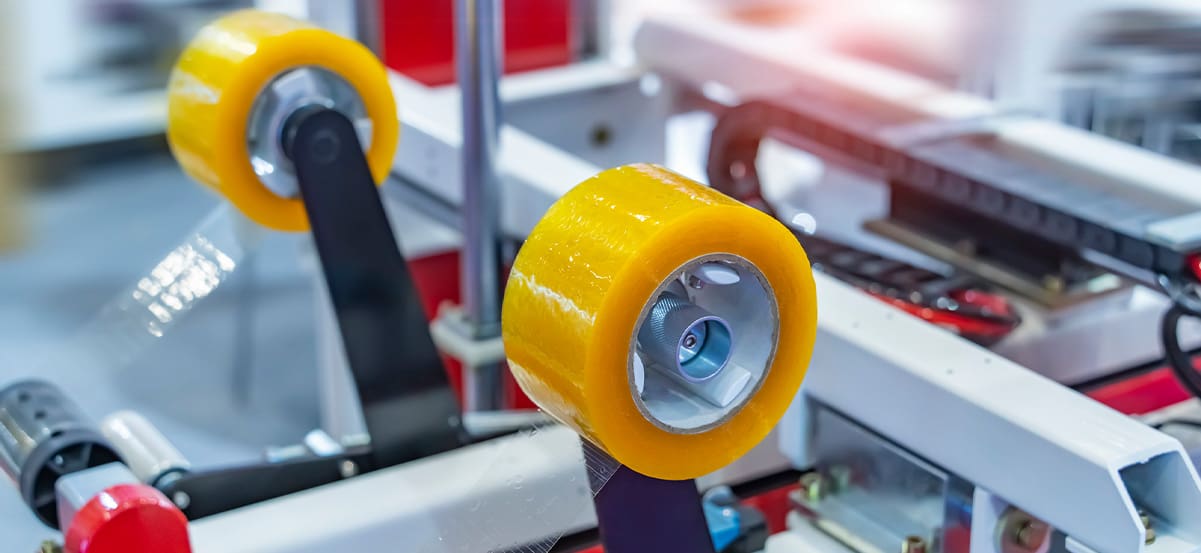
The changeable metric in tape consumption is more technical. As a roll of tape gets closer to its cardboard core, the overall diameter of the roll shrinks. That difference in diameter plays with the tension dynamics within your equipment – making the tape more prone to breaking.
In many operations, operators choose to swap out the roll before it nears the center – rather than having to deal with the breakage. This is a consumption choice that should be weighed with its waste: roughly 10-15% of usable tape on every roll is discarded. That cost won’t show up as a line item, but it will result in a slightly higher tape order every month.
What Is Driving My Glue Consumption Costs?
Glue is different from tape in that you can control how much is used on each case. There are factors that can be adjusted to save glue, while still achieving a solid seal:
1. Thickness
Adjust the glue thickness. Many operations instinctually believe more glue = a safer seal, and increase the thickness of the bead for extra surety. But that’s often an inaccurate assumption.

2. Temperature
Set the glue temperature properly. The right temperature improves adhesion, so less glue is needed for a solid seal.

3. Timing
Adjust the timing of your glue application. Accurate timing applies glue only where needed, reducing waste and mess.

4. Pattern
Use a stitched pattern rather than a continuous stream of glue. It uses less glue and still delivers a strong seal.

Getting the Numbers Wrong: What Happens When Glue Settings Are Incorrect?
When glue adjustments go wrong, you can have some pretty sticky situations on your hands – pun intended. Consider these mistakes as an incentive to get the numbers right:
- Downtime – A glue system that isn’t sealing cases, requires maintenance or a service call. It also takes time for someone down the line to either re-pack the case or add a tape seal.
- Incorrect Setup – Leads to over consumption of the consumable, as well as overspray.
- Mess – A dispenser that misses the mark (even slightly) can build up into a big mess, when it’s repeated ten thousand times over.
- Charring – If the line stops and the glue system isn’t setup to go into standby mode. Hot-melt glue stays running, and your machine is facing stilled glue at 350°. It will quickly char the hoses and nozzles.
Charring is the most expensive standalone failure. Recovering the machine from charring means purging the whole system and sometimes replacing components.
Some machines have a “standby mode,” which can lower the temperature to prevent this. However, it’s common for operators to skip standby to avoid the heat-up wait. And when they don’t practice using the standby mode, they slowly forget how to manage it until it’s too late.
A Valuable Insight: Glue Audits
An overlooked way to see long-term savings in your glue consumption is through audits. These are called “glue supplier process audits,” a fancy term for a usually-free evaluation of your glue consumption.
A representative from your glue supplier will come to your facility, do a brief evaluation, and provide you with results. These results can be helpful in confirming whether your facility uses the proper setting for glue:
- Formulation
- Temperature
- Dispensing time
- Dispensing volume
- Pressure
Most operations have never had one of these audits performed. And given the fact that it’s usually free, it’s an easy way to invest a little time in long-term consumption savings.
Is Adhesive My Only Consumable?
For most operations, tape or glue (and in some cases, both) is their only recorded consumable. Cases are used in the same way as adhesive, but they’re usually considered inventory. However, we pose yet another third consumable:
1
Tape
2
Glue
3
Compressed Air
How Is Compressed Air Considered a Consumable?
No, compressed air doesn’t look like a consumable – it’s invisible and somewhat intangible – and it’s rarely included on a consumables record. However, think about how it’s used:
- Runs air cylinders
- Provides suction in vacuum systems
- Supports glue tank
According to our estimates, somewhere around 90-95% of the equipment in some packaging lines relies on compressed air. So, though it is invisible, compressed air plays a major role in producing your packaged cases.
How Do I Count Compressed Air as a Consumable?
Compressed air functions in a continuous draw, more like electricity than tape or glue. How you intend to track the cost of compressed air as a consumable, is entirely your choice.
We’ve seen an operation that tracks compressed air as a known cost per cubic foot. An unverified figure that came up in conversation, put compressed air at around 18-30 cents per 1,000 cubic feet.
Now, that is a loose estimate, not a benchmark. It won’t mean much to you without your actual usage figures. But it provides you with a starting place: if you don’t already know your plant’s compressed air cost, start by asking the question.
Factors at Play When Consumables Underperform
It’s hard to know what the cause is when consumables underperform. Settings, supply, processes – it all requires a bit of evaluation before you can find the cause. So, we’re here to point out the factors that can complicate this situation further – the relationships that lock you into your current line.
How Do Tape and Glue Contracts Affect Underperformance?
Tape and glue are usually bought under contract, for a set period. If you haven’t already entered into a contract, it’s worth exploring your options – these contracts tend to be helpful until something goes wrong.
When consumables underperform, it can turn costly really quickly. Materials can be expensive on their own, but when they underperform, you have to pay to fill their gap. You don’t want to be locked onto a consumable that costs more than it merits.
That’s when the contract comes into play. The amount of flexibility in your contract is dependent on your supplier. You could be locked into a tight contract, with underperforming materials – it’s costly to stay, and costly to leave. When entering into a contract, make sure your supplier is willing and able to ensure you have the best consumables for your application.
Is Tape and Glue Optimization Your Choice to Make?
When consumables underperform, it’s a natural instinct to explore options for optimization. Perhaps you want to upgrade your machine and switch from tape to glue; perhaps you want to adjust settings, so the closure pattern is slightly different.
But it’s worth noting that you don’t always have the ownership over the tape and glue decisions. Sometimes your company has a specified closure method – especially if you’re a co-packer, working under customers’ conditions. Sometimes Marketing decides, based on visual appeal. And some operations have had problems in the past, and go for a belt-and-suspender sealing automatically – glue the top and bottom with tape over the seams.
Make sure you know how flexible your decision power is. And if you’re looking at new equipment, you might want to consider a dual-adhesive machine that can be flexible to tape or glue, no matter what demands are made.
Six Questions to Ask Before Your Next Materials Order
If you’re trying to get to the bottom of your consumption costs, a good place to start is by asking questions. The more you have recorded and documented from your team, your supplier, and your equipment, the better chances you have of curbing the spend.
Is our consumables issue actually a downtime issue?
Track tape breaks, glue stoppages, and corrugate jams as downtime events. Don’t track them as part of your materials cost. The stopped line may be what’s actually driving costs.
When was the last time our supplier audited our process?
Many suppliers offer glue audits for free, and most plants never ask for it. They’ll give you an evaluation of your formulation, temperature, timing, volume, and pressure.
How much tape are we leaving on the roll when we discard it?
If your operators swap roles to avoid breakage, there’s probably a 10-15% recurring loss hiding there. It’s an easy fix, when you know to look for it.
What does our supplier contract support?
Talk to your supplier about the underperforming material. If possible, collaborate with them to evaluate a better-fit material for your system.
Are we using standby mode on the glue tank?
If you have standby mode capabilities, but aren’t using them – you’re risking char with every unplanned stop. You don’t have to purchase a new machine, just check habits and fix processes.
Do we track compressed air as a consumable?
If you’re not tracking compressed air as a consumable, that’s a real gap. Air runs most of your equipment, and its cost is easy to lose inside a general utility bill. You can keep better track of your consumption, when you know it’s there.
How to Track Your Consumables’ Cost
It’s practically impossible to track consumables as a clean percentage of total cost on a packaging line. What’s more realistic to track – and simpler to improve – is the little details that occur on your line every day. Are you wasting tape or glue? Is standby mode being overlooked? Is your contract capitalizing without you noticing?
None of these fixes require new equipment or crazy spending. They just require someone to do the work of asking the questions.
Have Questions About Consumables and Your Equipment?
Schedule a discovery call with INSITE. Our team of experts will answer questions about tape and glue machines, evaluate your concerns, and advise your line.