Introduction
At a Glance
Cobot palletizers tend to cost from $80,000 to over $220,000, depending on system quality, flexibility, and speed. The question is whether their safety and ability to work alongside manual laborers is worth the investment.
Oftentimes, the justification comes down to two factors, and how they’ve impacted your operation thus far:
- Headcount
Palletizing stations are hard to staff, and labor is scarce. Cobot palletizers can reduce your headcount, while still working with other human operators and without the need for extensive fencing. - Egronomics
Palletizing tends to cause frequent injuries and strains for human workers. This can drive staffing problems, downtime, and injury costs. Cobots reduce injuries and limit their effects.
If palletizing is still manageable for your operation by hand, then perhaps it’s not time for a cobot palletizer. However, if these issues are significant, they may justify the investment. Then your next step is to figure out which cobot palletizer suits your needs.
Palletizing tends to rank with case erecting at the top of the packaging line’s ergonomics tower. Lifting cases from the floor to shoulder height (or higher) levels, for hours every shift, is a pain that is felt in more than just the worker’s body. It’s felt in your budget, in your downtime, and in your staffing too.
Traditionally, industrial palletizing robots were the solution. However, palletizing robots require significant floorspace, and they’re hard to integrate into an otherwise manual line. That’s where cobot palletizers come in. They’re the collaborative cousin of the traditional robot – they can run without fencing but tend to be a bit slower.
But cobots are slightly more expensive than a traditional robot palletizer. That’s because of their flexibility and high-tech sensing. The question is whether that flexibility is worth it for your team.
In this article, we’ll cover:
- What distinguishes cobots from robot palletizers
- Typical price ranges for entry-level and mid-market cobots
- Cost adders, cost drivers, and cost justifiers to account for
- Questions to ask vendors to evaluate cobot options
What Are Cobot Palletizers
The first distinction to make is that the term “cobot” is an abbreviation. It stands for, “collaborative robot,” and the name is a great description for its function. Cobots are designed to work alongside human operators, without the need for safety fencing.
Where traditional robotic systems would need a safety perimeter, interlocked doors, and other space and safety features, cobots run slower and use sensors to stop the system on contact. This means that they can work alongside operators without fencing – effectively cutting down their footprint, and making them appealing to lines with both manual and automated labor.
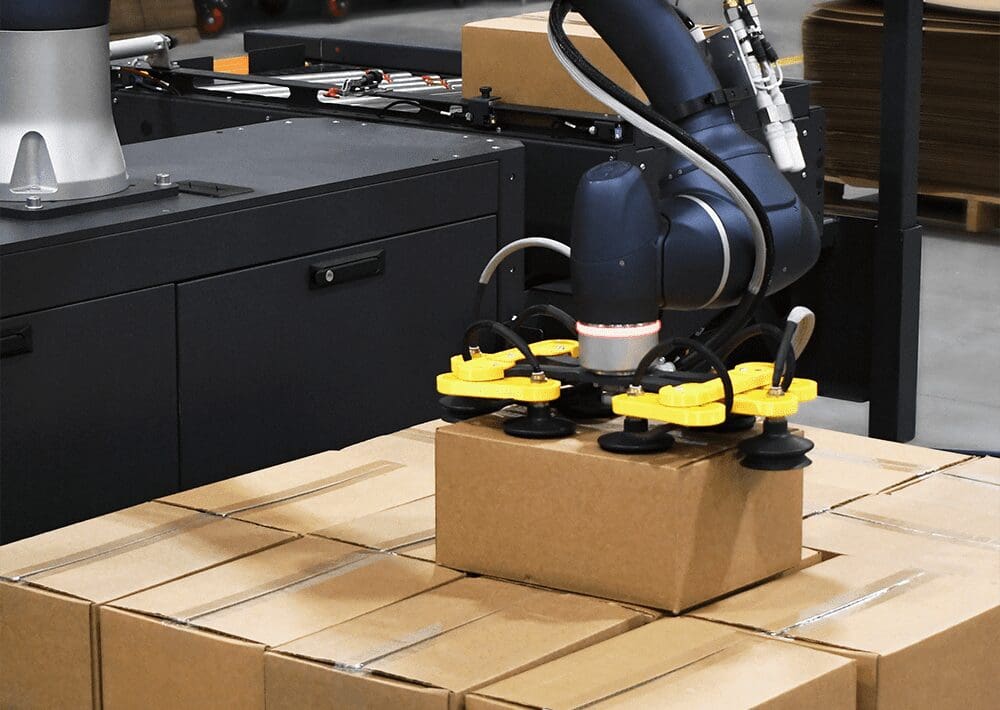
Now, cobot palletizers – to understand them simply, do the work of a traditional palletizer, but with a robotic arm that is designed to work around people. They stack cases on a pallet, by a specific pattern, but can do so in close proximity to operators.

Industrial Palletizer with Fencing

Cobot (Collaborative Robot Palletizer)
How Do Entry-Level and Mid-Market Cobots Differ?
The first difference you’ll notice between entry-level and mid-market cobots is the price. Entry-level cobot palletizers are available for as low as $80,000, while mid-market ones tend to range from $200,000 to $220,000. Doosan-based cobots – which are a current cobot market leader – fall in that mid-market range.
But what accounts for the difference? Where are the prices coming from? There are three main differences in capabilities between entry-level and mid-market cobot palletizers:
1
Speed
Higher quality cobots have better internal sensing, which allows the robot to move faster while still meeting cobot safety standards. Lower quality cobots aren’t as sensitive and therefore must move slower.
2
User Interface and Recipe Flexibility
Premium systems allow operators to enter basic case dimensions and create new palletizing recipes on their own. Some cheaper systems don’t have this, and the vendor’s support team will need to make a visit when a new recipe or pallet pattern is built.
3
Build Quality and Vendor Support
High quality systems are going to have more standardized support options. On the other hand, lower quality systems are going to vary in what they offer for quality, warranty, and support.
What Costs Come After the Quote?
Most costs that come after the quote are optional, or smaller than buyers initially assume. Here are some key costs:
Installation and Commissioning
Most operations with in-house engineering can handle these steps themselves, keeping additional costs down. If you want someone from your vendor to come in and handle them, that will be a cost add-on.
Software and Subscriptions
Some cobots run on unique software that incurs ongoing licensing fees. Others, like Doosan, run on Python – an open-source coding language – so there are no additional subscriptions and licensing costs.
Maintenance
The main maintenance needs on a cobot are usually gearbox oil changes – these are a recurring service item, typically needed every 3,000 hours running. Other support and warranty terms vary by vendor, so you’ll want to seek specifics early on.
What Factors Justify ROI for Cobot Palletizers?
There are two factors that justify the return on investment (ROI) for a cobot palletizer:
1
Headcount
While a cobot doesn’t replace all manual workers, it can displace some of the manual headcount needed for the palletizing step of the line.
2
Ergonomics
Cobots can reduce the number of injuries sustained due to palletizing, and they can limit turnover in palletizing positions.
That second point can make a big difference – palletizing traditionally requires a manual worker to lift cases from the floor to 60, 70, or 80 inches up. It’s a common cause of injuries, which can make palletizing positions difficult to staff.
But whether these points justify the ROI is dependent on your line. If the job is still manageable by manual labor, perhaps it’s not time for a cobot palletizer. If these challenges are significant, it’s likely time to explore cobot options.
What Questions Should I Ask Before Buying a Cobot?
To make sure you’re getting the cobot palletizer to support your needs, it’s important to ask good questions during the buying process. Here’s our recommended list:
What line rate can the cobot sustain? How was that number tested and calculated?
The best vendors will give you specific, tested speeds. Some vendors might be estimating, so it’s often best to ask for the documentation.
Will our operators feasibly be able to set up a new pattern without a service call?
If you’ll need to make a call every time you set up new patterns, try to get a realistic estimate of cost and frequency. But whether this is ultimately a deal breaker is up to you.
What robot arm forms the core of the system?
The arm manufacturer matters. It will affect sensing quality, speed capability, and parts availability for the life of the system. If you’re not familiar with their answer, you’ll want to do some research to evaluate whether it will suit your needs.
Is the robot designed to current safety standards (ANSI and ISO) for collaborative applications?
This question is a good check, and relevant to keeping your operators safe as they work alongside the system. It is best to ask for your answer documented in writing.
Who Manages Cobot Safety Standards?
ANSI stands for, “American National Standards Institute.” They “oversee standards and conformity assessment activities in the United States.” ISO stands for, “International Organization for Standardization.” They manage standards on a global level, syncing activities across the world
What will installation and commissioning cost if we want your team to do it?
Get an estimate of self-install costs and vendor-supported costs. This will allow you to realistically evaluate the two and decide which is the better choice for your team.
What is included in the warranty? What does maintenance look like at 3,000 hours?
Gearbox servicing will likely be the main maintenance item. You should know what it costs, and who is going to perform the service.
Can we see the system run our cases before we sign a purchase order (PO)?
Most manufacturers will freely offer a recorded demo, some will do a live video session, but the best will let you see your actual product running through the system.
Is a Cobot Palletizer Really Worth It For Me?
Cobot palletizers are often a significant investment, so it’s best to intentionally think through the purchase with your real line in mind. Evaluate cost, quality, installation, maintenance, and capability as they seek to fit into your current operation.
And don’t forget to consider your line not only as it is now, but also as it will be a few years from now. For most operations, self-sufficiency is important to protect as they grow – that has a real dollar-value that won’t show up on a quote. Make sure you find the vendor who will look out for your team’s best interests, rather than the one just working for the sell.
Looking to Explore Cobot Palletizers?
Give INSITE a call. Our specialists can answer questions, explore options, and evaluate whether the cobot investment is justified in your line.