Introduction
At a Glance
Parameterization is a feature that allows the case erector operator to create a new case size recipe within minutes. It eliminates the hassle of what can take hours (or days) to accomplish with a service technician and provides the key to SKU repeatability.
Parameterization on INSITE’s case erector takes a few simple dimensions and then automates robot path generation and changeover settings. This allows you to get the job done before it’s time for lunch.
Your case erector can’t keep up with the expansion of your company and product lines. You establish a new product, acquire a new case size, and attempt to create a new recipe on your case erector. You’re met with a complicated, traditional process with a service call, a technician visit, multiple mechanical adjustments, and a bill.
Just like that, your bottleneck forms.
Your bottleneck doesn’t have to be inevitable. Rather, consider how your production capabilities can scale along with your company. To every problem, there’s a solution. In this case, your solution is case erector parameterization: a simplifying feature with a complex name.
Read on to learn how a case erector can use four dimensions to create new SKU recipes through parameterization.
In this article, we’ll cover:
- What parameterization is and how a new recipe is prepped
- Why the traditional model (a service call and technician visit) is costly in more ways than one
- How parameterization offers unique value both in reliability and in the needs of different SKU mixes
- How parameterization gives you your time back
So, What is Parameterization?
Parameterization is a machine-operated sequence that automatically programs your case erector to meet the dimensions of a new case size.
It’s as simple as that. But let’s get into the details – which starts with understanding how a case erector works:
- The operator selects a recipe in the human-machine interface (HMI).
- The case erector reads the recipe, makes automatic adjustments, and the operator completes any physical adjustments.
- Once adjustments are completed, you can start erecting cases.
The key to repeatability in this process is the recipe: the information stored in the machine for each case size. Using the same recipe means consistent case erecting and faster production.
To learn more about case erectors, check out our article, “What is a Case Erector and How Does It Work?”
Traditionally, a recipe is created by physically adjusting each component of the machine and the parameters in the programmable logic controller (PLC) to match the new case size. Given the level of difficulty, most cases require a service technician from the OEM to create the recipe. It can be a frustrating process with lots of opportunities for human error, resulting in mis-erected, crushed cases and machine jams.
Parameterization simplifies this process with greater reliability. It produces the same recipe, but through a simplified PLC experience and machine-operated robot path generation and changeover settings.
So, what does this actually look like on the machine?
How Parameterization Works
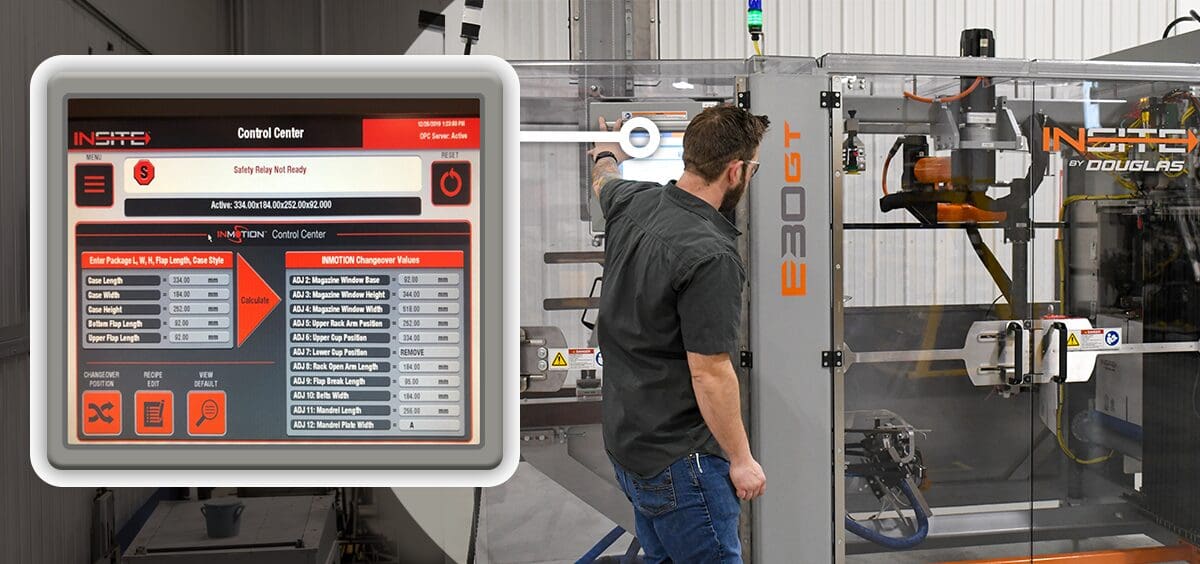
The operator enters four simple case dimensions into the HMI:
- Length
- Width
- Height
- Flap length
And that’s it. Just four dimensions.
Parameterization takes the art out of recipe creation and turns it into a simple science.
The machine takes those dimensions and automatically calculates the positions for each adjustment point, creates the new robot path, and walks the operator through any steps that need physical action. There’s no trial and error, no eyeballing measurements, and no technician on speed dial.
The whole process typically takes less than five minutes, and first runs succeed ~96% of the time.
What About the Other 4%?
The other four percent of first-run failures are largely caused by material issues. That means the cardboard itself – not the machine.
Cardboard issues cluster in two, main, production failures:
- The makeup of the cardboard – design and tolerance issues which vary from standard recipe (e.g. blanks that drift from spec, dimensional variation within a single supplier’s lot, or lot-to-lot variation between suppliers).
- The storage of the cardboard – altered case geometry (due to temperature, humidity, or stacking) before material reaches the machine.
These failures point to the need to speak with your corrugate supplier or to evaluate your storage methods. Fortunately, parameterization uncovers these issues before they impact production.
How Parameterization Cuts Costs…
If you’ve ever created a new recipe on a case erector, you’re familiar with the traditional process:
- Use trial-and-error to learn what measurements were needed
- Configure each machine component to match
- Give up, and call the original equipment manufacturer’s (OEM’s) technician to facilitate
Not only is this a frustrating process, but it also becomes time-consuming and costly.
An on-site technician costs around $2,200 per day, and servicing usually lasts from a few hours to a few days, depending on complexity. You’re paying upwards of a few thousand dollars before we add in airfare, hotel stays, and per diem. And don’t forget to account for the lost productivity while waiting for the technician to arrive.
The cost of adding a single recipe comes close to 20% of the machine’s original price. With multiple SKUs, that number keeps creeping up…. Parameterization cuts both costs.
With parameterization, the recipe is:
- Done by the machine operator
- Guided by the machine
- Finished the same day the cases arrive
- Ready to go before lunch
Just like that, your operation is ahead of competitors on promotional windows and retailer commitments.
…And Prevents Knowledge Gaps
With parameterization, setup knowledge moves out of the service contract and into the machine itself. It provides a bigger shift than speed: where the knowledge lives.
You’ve likely run into traditional timeline issues like:
“John Doe’s not responding to his email,” or “Jane Doe and I can’t find a time to meet.”
These problems happen when the knowledge lies in the service contract. Parameterization bridges these gaps by storing set-up know-how in the machine. Your operator can take the machine prompts, plug in the case measurements, and complete any physical adjustments without any wait.
It’s not a substitute for good operator training or strong service relationships, and it’s not asking you to sacrifice the experienced staff you value. But parameterization is making sure the line has reliability when wait times and knowledge gaps occur.
How Parameterization Compounds Value
For a single-SKU facility, parameterization’s value shows up at initial machine setup and whenever a new product gets added to the lineup. It’s not value that’s seen every week – it’s a one-time-cost-savings feature that also provides future insurance.
For a co-packer or high-mix operation cycling through dozens of SKUs, the savings compound differently. Each new product skips the cost of a service-call, a scheduling delay, and an operational headache. Across a year, the difference parameterization makes is measurable in money and production time.
Parameterization: Get the Job Done Before Lunch
The traditional model has a logic to it. Complex machines require specialized knowledge, and specialized knowledge means a service contract. The system works. But it also means every new case size is contingent on someone else’s availability… and billed at their day rate.
Parameterization breaks your dependency. The operator who sets up a new case size before lunch isn’t doing anything extraordinary, costly, or time-consuming. And that’s the point.
Want Your Time Back?
Parameterization is growing in the secondary packaging industry, but:
- Not all OEMs offer it, and
- Capabilities can vary widely in scope.
The parameterization outlined in this article is specific to INSITE case erectors. Many OEMs still rely on the traditional method. Discuss with your OEM what parameterization looks like on their machines. Is it standardized? Is it not offered at all? This clarification will take time upfront but saves you time and money down the line.
Curious About INSITE’s Parameterization?
Give us a call. INSITE’s team of specialists are here to answer questions and clarify equipment features.