Introduction
At a Glance
Palletizer choice comes down to what matches your operation’s individual throughput, SKU mix, floor space, and capital profile. Here are the 3 main types of palletizers and how to factor them into your choice:
- Low-level conventional: simpler construction, smaller footprint, lower capital cost. Common choice for operations first automating but limited in capacity.
- High-level conventional: common choice for speedy operations but requires vertical clearance and substantial floor space.
- Robotic: compact design with a multi-axis articulated robot, using end-of-arm-tooling. Flexible and adaptable, with programmable customization
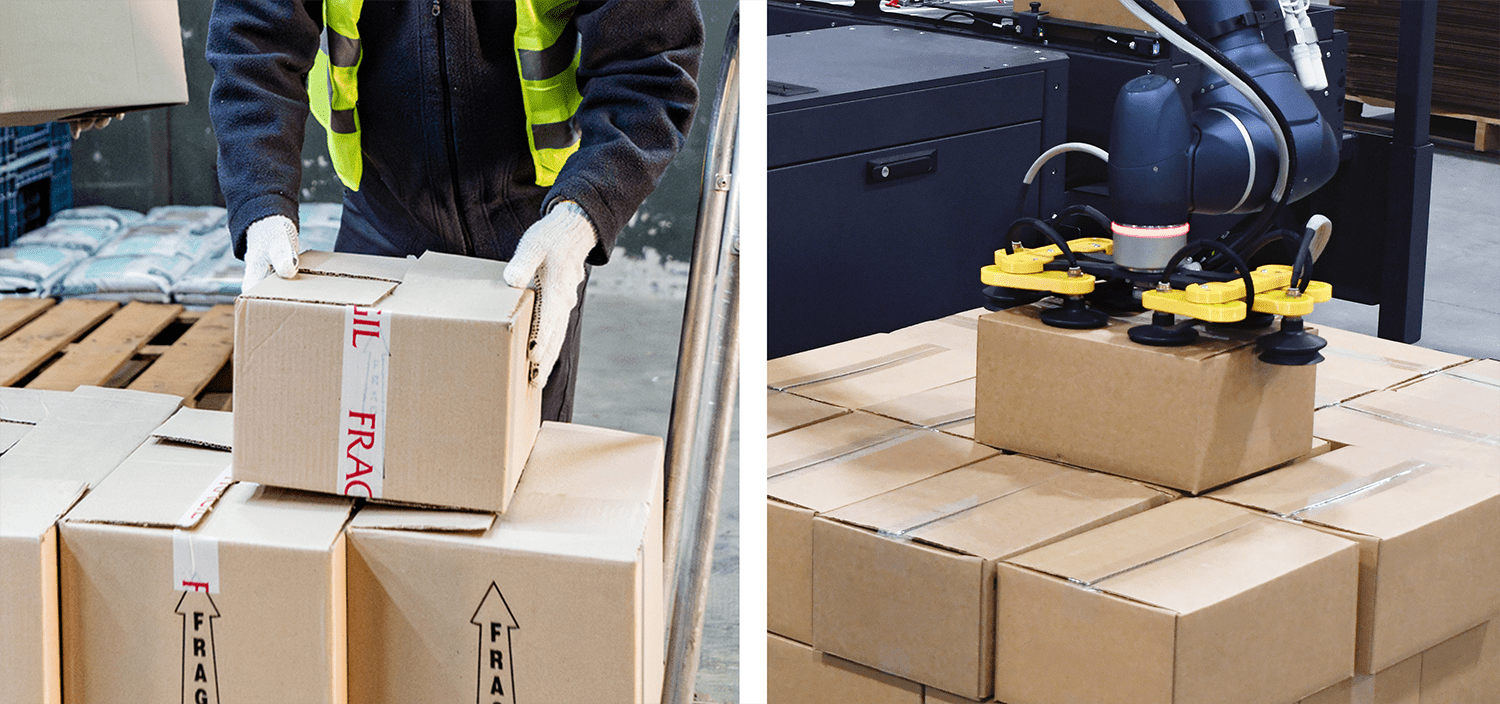
So, you’ve decided to automate your line with a palletizer. This choice will keep your workers safer (as palletizing is one of the most dangerous aspects of production) and boost your efficiency.
But now, you’ve realized that there are many types of palletizers and each one sports its own list of specs, strengths, weaknesses, and cost. Do you go conventional or robotic? How do you know whether you need floor-level or elevated infeed? Is flexibility important?
In this article, we’ll cover:
- The differences between the three main types of automatic palletizers
- The four deciding factors that drive buyer choice
- The cases where the answer of “What’s right?” is clear and the cases where it isn’t
- A side-by-side comparison of the dimensions that matter
- The questions all buyers should be asking their OEMs about palletizers
What Are the Three Main Types of Automatic Palletizers?
Automatic palletizers fall into two categories: conventional and robotic. From these categories, they split into three main types based on build, complexity, and function. Let’s unpack what makes these palletizers unique.
The Three Main Types (and a Bonus Fourth)
Conventional Palletizers
The category of conventional palletizers is broad but united around the same core: mechanics. They work by using multiple mechanical stations to complete various tasks – for example, a station to form the cases into rows is separate from a station where layers are built.
Two of the three main types of palletizers fall into this category.
- Low-Level Conventional Palletizers
- CPM: 10-30 cases per minute (CPM) is average, but certain customized palletizers may be able to do up to 45-70 CPM
- Footprint: 150-250 square feet (sq. ft.)
- Capital Cost: $100-000-$300,000+ (depending on requirements)
- High-Level Conventional Palletizers
-
CPM:
- 30-60+ CPM on average
- 100+ CPM on high-speed
- 180+ CPM on fastest speed
- Footprint: 250-500 sq. ft. plus vertical clearance for the elevated infeed
- Capital Cost: $250,000 – $500,000+ (depending on speed and other requirements)
Low-level conventional palletizers receive cases from a floor-level conveyor, form rows on a staging surface, and then transfer rows to a floor-level pallet. They are known for simpler construction, smaller footprint, and lower capital cost.
These palletizers are a common choice for operations first moving from manual labor to automation due to its ability to fit into existing manual palletizing stations without major interruption to overall flow.
Specs:
High-level conventional palletizers receive cases from an elevated infeed, which is positioned above the height of a fully constructed pallet. Cases are directed from this conveyor, oriented and grouped into rows. Rows are lifted onto the pallet by hoist or sweep mechanism, while the pallet is raised to meet each new layer.
These palletizers have a reputation for speed. However, they are large and complex machines that can be difficult to install in existing operations.
Specs:
Specs
Low-Level Conventional Palletizers
High-Level Conventional Palletizers
CPM*
Low-Level Conventional Palletizers
10-30 CPM on average; customization may allow up to 45-70 CPM
High-Level Conventional Palletizers
30-60+ CPM on average;
100+ CPM on high-speed;
180+ CPM on fastest speed
Footprint
Low-Level Conventional Palletizers
150-250 square feet
High-Level Conventional Palletizers
250-500 square feet
Capital Cost
Low-Level Conventional Palletizers
$100-000 – $300,000+ (depending on requirements)
High-Level Conventional Palletizers
$250,000 – $500,000+ (depending on speed and other requirements)
*CPM = Cases Per Minute
Robotic Palletizers
Robotic palletizers use a multi-axis articulated robot fitted with end-of-arm tooling (EOAT) to pick cases from an upstream conveyor and place them on a pallet in a pre-programmed pattern. Separate mechanisms like row-forming or layer-building are eliminated. Instead, the robot’s programmable pick-and-place capability performs these same mechanisms sequentially.
The biggest benefit of robotic palletizers is their flexibility. Switching from one pallet pattern to another is just a software change and sometimes a tool swap, but with no manual reconfigurations. Multiple SKUs can be handled at once via a barcode reader or vision. The same cell can also sometimes feed multiple lines, which is a limitation of conventional palletizers.
Specs:
-
CPM:
- Single-Pick Design: 8-35 CPM
- Row-Pick Design: 50+ CPM
- Multi-Arm Cells or Specialized High-Speed Inline Designs: 100+ CPM
- Footprint: 225-625 sq. ft. (15-25 ft. on a side, including all conveyance, pallet staging and safety guarding)
- Capital Cost: $200,000-$400,000+ (depending on requirements)
Collaborative Robotic “Cobot” Palletizers (Bonus)
Cobot palletizers are designed to safely operate near people, with an added feature of built-in force sensing. This stops the robot if it comes in contact with anything. Other robotic palletizers also have trigger sensing, but this is through safety fencing, as opposed to sensing being built into the robot itself.
While slower than traditional robotic palletizers, cobots offer the advantages of smaller footprint and lower cost. They make good alternatives for companies looking to improve labor efficiency while saving space.
It’s important to note that cobots are limited in capacity. Operations with heavy cases or higher throughput will need to stick with other palletizer options.
If you want to learn more about any of these palletizers, check out our article, “What is a Palletizer and How Does Automated Palletizing Work?”
How Do I Know Which Palletizer Is Right for My Operation?
Palletizer decisions are usually based on the following key areas: throughput, SKU and pattern variability, floor space, and capital profile.
Let’s look at each of these closer.
Throughput
Throughput requirement is typically the first factor in play.
- Lines above 60 CPM: Typically high-level conventional or specialized high-speed robotic. These palletizers will keep up with your speed.
- Lines at 30-60 CPM: All three types are options for you, so your decision will be based on the other three deciding factors.
- Lines below 30 CPM: Low-level conventional or robotic solutions are generally the best choices. The decision will come down to your needs for variability and floor space.
SKU and Pattern Variability
Operations that run the same product, at the same size or pattern won’t find much value in the flexibility robotic palletizers offer.
In contrast, operations that run many products with frequent SKU changes, multiple pallet patterns, or mixed-load palletizing, will feel the value in robotic flexibility in every changeover.
Floor Space
Constrained spaces will be more suited to low-level conventional or robotic palletizers. Robotic solutions offer the smallest footprint options and can save even more space when palletizing multiple parallel lines.
Capital Profile
In the high-speed band (60+ CPM), high-level conventional solutions will be most cost efficient. For all other operations, low-level conventional will generally offer the lowest overall cost, but robotic palletizers show competitive rates. Robotic solutions are considered premium across the board but earn it back via flexibility and changeover speed.
Operating-cost differences across all three are smaller than commonly assumed – robotic electrical consumption is real but modest; conventional mechanical maintenance is real but predictable.
What if My Decision is Clear and What if it Isn’t?
Sometimes, an operating profile will clearly point to one type of palletizer. For example, an operation looking to just start in automated palletizing, with constrained space, low budget, and lower CPM, will want to explore low-level conventional palletizers.
However, certain situations may merit two or even all three of the three main types of palletizers. Unclear decisions are often because an operation measures in the middle of multiple factors. Their decision will ultimately come down to performance, priority, and projected growth.
To evaluate how many of the three main types of palletizers will be viable for your situation, consider our comparison table below:
High-Level Conventional
Low-Level Conventional
Robotic
Typical throughput
High-Level Conventional
30–60+ cases/min (100+ on high-speed configs)
SKU/Pattern Flexibility
10–30 cases/min
Robotic
8–35 cases/min single-pick; 50+ row-pick/multi-arm
SKU/pattern flexibility
High-Level Conventional
Lower (mechanical setup)
SKU/Pattern Flexibility
Lower (mechanical setup)
Robotic
Higher (software-driven)
Footprint
High-Level Conventional
Larger (250–500 sq ft + vertical clearance)
SKU/Pattern Flexibility
Smaller (150–250 sq ft)
Robotic
Moderate (225–625 sq ft cell)
Capital cost
High-Level Conventional
Lower at high throughput
SKU/Pattern Flexibility
Lowest at moderate throughput
Robotic
Can be higher (depending on requirements)
Best for
High-Level Conventional
High-volume single SKU, stable patterns
SKU/Pattern Flexibility
First-time automation, moderate throughput
Robotic
High-mix SKU, frequent pattern changes, multi-line cells
Examples of Unclear Decisions
- A co-packer with multiple infeed lines can either:
- Use multiple low-level conventional palletizers, with one per line, or
- Use one to two robotic cells, each serving multiple lines.
- A mid-volume operation running 25-40 CPM, with moderate SKU mix will have the options of low-level conventional or robotic palletizers:
- Low-level conventional will offer lower capital cost and very stable mechanical operation.
- Robotic will offer easier SKU expansion and the option to serve a second line.
- A brownfield retrofit operation running 40-60 CPM will have the options of high-level conventional or robotic palletizers:
- High-level conventional will deliver clean throughput but require floor space and vertical clearance.
- Robotic will more easily fit the floorplan but may need a multi-arm or row-pick design to achieve throughput targets (which can mean a higher capital cost).
The robotic cell’s flexibility is more valuable, but the conventional approach is more predictable in throughput for sustained operation.
In this case, there is no “right answer.” The choice depends on how coordinated the infeed lines are. Robotic cells do well with uncoordinated lines, while conventional palletizers favor coordinated lines with high throughput.
The decision for this sort of operation will come down to where they see their company 5-10 years down the line. Will they be adding SKUs or going for consistency?
This decision will come down to a combination of operational and spatial needs.
What Should I Be Asking My Palletizer’s OEM?
Regardless of operational needs or priorities, all buyers should discuss the following questions with their OEM. Your OEM should help you decide if the palletizer you’re considering will be a good fit for your operation, both now and in the long term.
Under Normal Operation Conditions, What Throughput Can This Machine Realistically Achieve?
Spec sheet maximums are best-case scenario. Ask for sustained Overall Equipment Effectiveness (OEE) with your actual case mix, pattern complexity, and changeover frequency.
This question matters most for robotic options, where the gap between peak throughput and sustained throughput can be substantial.
What Will Changeover Look Like for Different Case Sizes and Patterns?
With the guidance of your OEM, walk through a typical changeover on the proposed palletizer. Conventional palletizers of all types vary widely in how easily mechanical adjustments can be made. Robotic palletizers vary widely in how easily you can edit software. The right answer may lie in the changeover capacity of your team and how user-friendly the platform is.
What Routine Maintenance and Service Will This Palletizer Need?
Conventional palletizers have predictable, scheduled, and mechanical maintenance patterns. Robotic palletizers have a different profile entirely: robot maintenance, EOAT replacement, and vision-system calibration. Confirm that your operation has (or can develop) the maintenance capacity that your proposed palletizer requires.
Palletizer Choice Should Suit Your Needs
The question of “What palletizer is right for my operation?” can be complicated. While the answer is sometimes clear, other times the decision requires deep evaluation of your operation’s performance, priorities, and projected growth over the next 5-10 years. Low-level conventional, high-level conventional, and robotic palletizers all offer strengths and weaknesses, and ultimately, there is no “one size fits all situations” type of palletizer.
If the choice of palletizer becomes overwhelming for your operation, consider giving INSITE a call. Our sales team handles complicated problems with simple solutions daily, and our automated palletizers are designed for ease of use.
Need Help Choosing a Palletizer?
Give us a call. INSITE’s team of specialists are here to answer questions and offer solutions.