Introduction
At a Glance
A decisive question: “Does a dedicated person close cases for most of a shift?” If yes, a fully automatic sealer is probably the right choice to save labor costs. If no – e.g. the operator only touches the sealer occasionally, or the whole line is hand-pack, hand-load – semi-automatic is likely the right, lower-risk choice.
Semi-Automatic vs. Automatic: What Makes the Difference?
Who folds the flaps
- Semi-Automatic: operator folding flaps and pushing cases into taper
- Automatic: machine folds, seals, and discharges cases
The human role
- Semi-Automatic: hands-on for every case
- Automatic: monitoring and consumables restocking
Purchase price
- Semi-Automatic: $5,000-10,000
- Automatic: up to $10,000-50,000+
But purchase price isn’t the hidden cost – compare overall cost over 2-3 years.
Beyond these factors, the question becomes largely situational. It’s dependent on your labor costs and where you’re at in automation.
When operations move further into automation, one of the first questions asked about case sealers is the difference between semi-automatic and automatic solutions. Which one is better, how are they different, how does pricing compare, etc. That’s what this article is focused on: should you buy an automatic or semi-automatic case sealer?
We’ll help you understand the difference, provide insights into pricing (and why it’s important to evaluate the hidden cost), and guide you through the deciding process, based on what we’ve seen as OEMs in the secondary packaging industry.
In this article, we’ll cover:
- The difference between automatic and semi-automatic case sealers
- Why purchase price is only one factor of the cost decision
- When semi-automatic is genuinely the right choice
- When automatic is the right choice
- A short framework for before and while working with vendors
The Big Difference? Who Folds the Flaps
The big difference between automatic and semi-automatic case sealers is who folds the flaps.
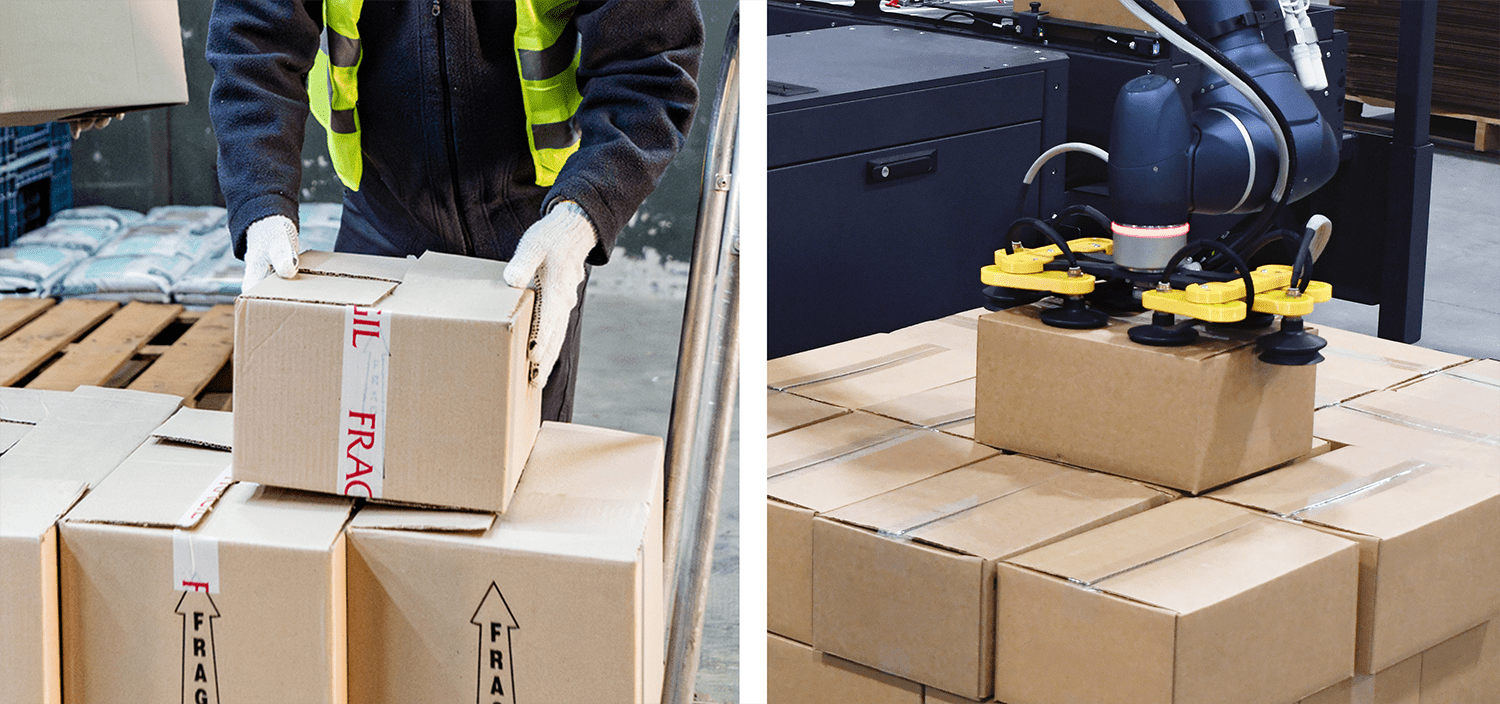
With a semi-automatic sealer, a worker folds the top flaps by hand and feeds each case into the taping mechanism. The machine’s main function is sealing – taping or gluing the case closed. The worker can also watch for jams and keep consumables (like rolls of tape or glue) stocked while they load and form.
With an automatic sealer, the case arrives flaps-up on a conveyor and the machine forms and seals the box without human intervention. Consumables are still stocked by hand. If a worker was manually closing cases before, they are now moved to a monitoring role.
The difference between case sealers is small on the surface, but each sealer carries its own repercussions to be dealt with. That’s what we cover in the rest of this article.
Purchase Price Isn’t the Only Cost Factor
One of the main questions buyers have is, “How much will an automatic vs. semi-automatic case sealer run?” The answer is that semi-automatic sealers run about $5,000-10,000; fully automatic sealers can run between $10,000 and $50,000+, depending on speed and robustness.
However important purchase price is, it’s only a one-time cost. The cost of labor is recurring. To understand the full cost of an automatic vs. semi-automatic case sealer, you need to add the labor costs onto the purchase price.
A semi-automatic sealer requires an operator, who costs an hourly wage, benefits, payroll burden, etc. An automatic sealer must be monitored, but the worker who does so can bounce between machines and roles, so the cost is shared. If the operator who is freed up from case sealing moves to a higher-value role, you’re actually benefitting in capacity.
When Semi-Automatic Is the Right Choice
Though automatic offers benefits, semi-automatic isn’t necessarily the wrong choice. Each type of case sealer is the right choice when the situation warrants it.
A semi-automatic case sealer is the right choice when:
- The operator only touches the sealer occasionally
If the sealer operator only mans the machine during a small part of their day, there’s no labor cost benefit offered by the automatic sealer. - The rest of the line is hand-pack, hand-load
If all the other steps are manual, an automatic sealer may be overbuilt for the operation. - It’s your first step toward automation
Semi-automatic sealers offer a low-cost, low-risk entrance to automation. Operators can get comfortable working alongside equipment, and you can learn pain points and plan future scaling. - You are budget constrained
If you’re a growing operation, with a tight budget, semi-automatic offers low-cost automation. You can always upgrade to fully automatic 2–3 years down the line.
When Automatic Is the Right Choice
On the other side of things, there are situations where automatic is the clear choice. Buying a semi-automatic sealer at this stage may even cost you money.
An automatic sealer is the right choice when:
- A dedicated worker closes cases most of the shift
When sealing becomes a full-time position, you have a dedicated labor cost sitting in the line. That’s the cost that automatic sealers remove. This is the single biggest signal that it’s time to upgrade. - Repetitive-motion exposure is taking its toll
Folding flaps and pushing cases all day is repetitive motion that causes strains and injuries. A fully automatic sealer avoids this cost by removing the operator-risk entirely. - You can’t find or keep labor
If your sealing station has a high turnover or is just hard to staff, you’re already paying extra recruiting and retraining costs. Automatic sealers remove your staffing dependency.
Is It Harder to Run a Fully Automatic Sealer?
Fully automatic sealers are more complex than semi-automatic. This is because they work the cardboard instead of just applying tape – the process requires a more involved control system. This doesn’t mean that the machine is harder to run than a semi-automatic sealer.
The variable that makes the difference is setup. The machine has to be configured for your specific corrugate board. Since corrugate varies in caliper, stiffness, and environmental behavior, an automatic sealer needs to be uniquely configured to run smoothly. Realistically, the automatic that is set up properly causes less disruption than a semi-automatic staffed by someone who can get sick, hurt, distracted, or interrupted.
Note: If your challenge is actually constant changeover (high-mix, low-volume, many case sizes) there’s a distinct machine suited for that. A random case sealer adjusts to whatever case comes through. It’s a possibility worth raising with your vendor if this scenario describes your line.
The Vendor Framework
Before you talk to a vendor, evaluate these questions internally:
- How many cases per shift does this station handle?
Low-volume points to semi-automatic; high-volume with a dedicated operator points to automatic. - Is the operator sealing-focused, or split?
Automatic can eliminate the cost of a dedicated operator, but not a multi-tasking operator. - How will this station look in three years?
Buy for your trajectory, not just today’s volume.
When you do talk to vendors, two questions are worth asking because they highlight the hidden cost beyond the quote:
- How does the machine handle board variability?
Ask for the range of corrugate board grades the machine is set up for, and what happens when one falls outside that range. - Can I talk to a customer running a similar volume and case mix?
Talking to a customer with a similar operation is worth far more than any vendor’s brochure.
The Bottom Line
Often, the question of buying an automatic vs. semi-automatic case sealer is a situational decision. For low-volume, multi-tasking operations, semi-automatic is the right answer. For an operation where sealing has become a dedicated position, the fully automatic sealer is the labor cost saver. The machine pays for itself and then keeps paying.
The buyers who truly make a mistake are the ones who only account for purchase price comparison, or today’s volume without thinking about their line three years from now.
Answer three questions and the right sealer will probably fall right out of their answers.
Evaluating INSITE’s Automated Case Sealer?
Give us a call. INSITE’s team of specialists can answer questions and discuss automation options.