Introduction
At a Glance
When two case erectors quote close on purchase price — as robotic and traditional machines often do — try comparing loaded cost over three to five years instead. These are the factors to consider:
- Changeover Labor: If you frequently perform changeovers, it’s valuable to buy a machine with fewer change points – this usually ends up being robotic. But if you only run one case size, changeover may not be a deciding factor for you.
- Parts Count and Wear: A robotic erector built around a servo-driven arm carries fewer mechanical parts than a comparable traditional machine. This means fewer parts to maintain and replace.
- Workforce Resilience: As experienced maintenance staff retire, a machine that adjusts from a saved recipe is easier to keep running than one that depends on someone who knows it by feel.
Traditional case erectors tend to win at speed, maximum and minimum case sizes, single recipes, and when your workforce is adequately experienced and not at risk of turnover.
As solutions evolve, the question of whether to invest in robotic vs. traditional case erectors grows. Logically, buyers want to know: “Which case erector costs less? Traditional or robotic?” It’s natural to assume that traditional takes the cake every time. However, the answer is more complicated and surprising than it first appears.
Traditional and robotic case erectors often fall into the same ballpark on purchase price. It’s surprising, but true. But both types of case erectors can see overall cost increases on a variety of factors:
- Parts count
- Integration complexity
- Changeover value
- Ease of use
So, to really get to the heart of this answer, let’s look at what makes the cost difference.
In this article, we’ll cover:
- Why robotic and traditional case erectors fall in the same price range
- Why purchase price doesn’t show the whole picture
- The cost factors that never appear on a quote sheet
- When a traditional case erector is the right call
- The questions to ask any vendor before you sign
How Traditional vs. Robotic Case Erectors Work
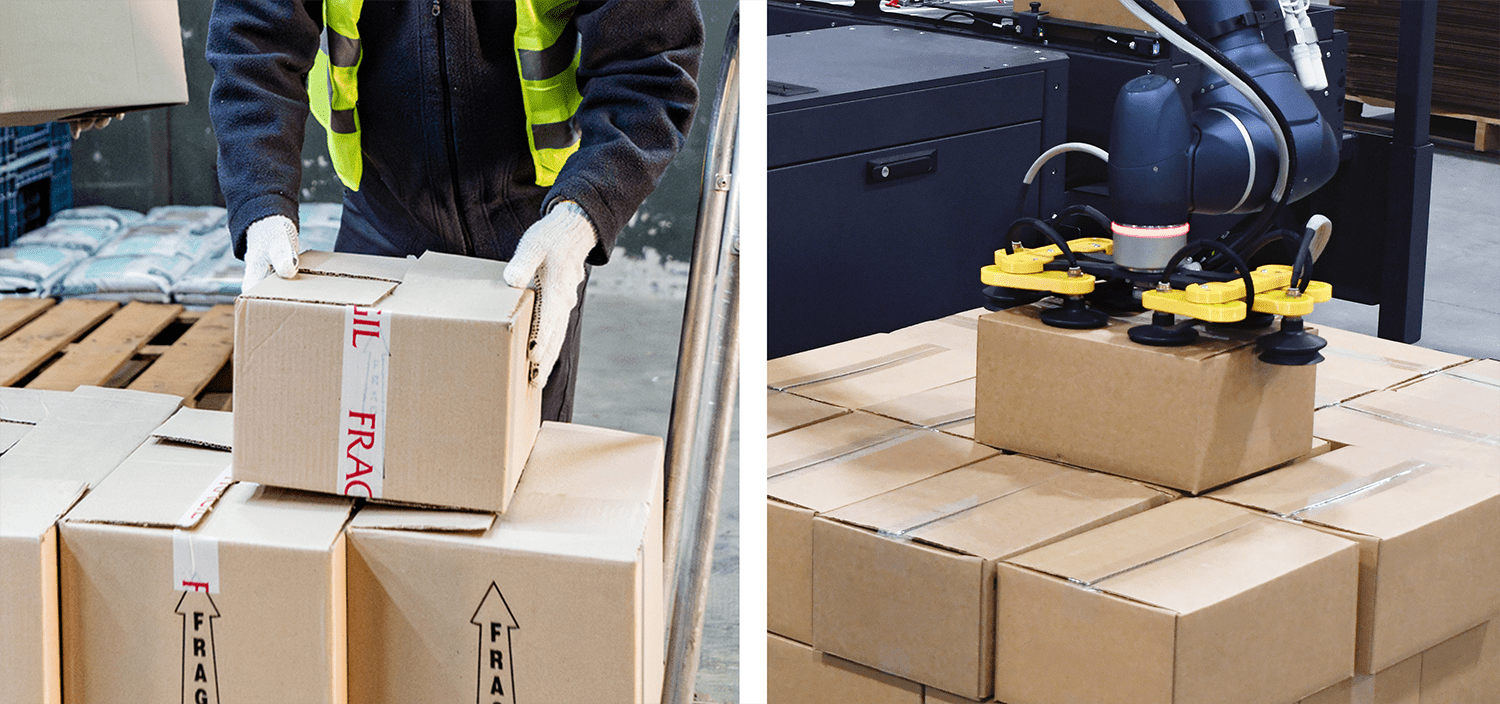
Robotic case erectors are not like C3PO from Star Wars – they’re not a humanoid machine wandering the plant (as cool as that would be). They typically use a Selective Compliance Assembly Robot Arm (SCARA). It’s an arm with a limited range of motion, driven by servo motors. It picks up a flat case blank, opens it, and positions it on a mandrel so the bottom flaps can be sealed.

Traditional case erectors produce the same result but complete the job in a different way. They use multiple mechanical axes of motion: handoffs, air cylinders, and fixed adjustment points (which are set by hand for each case size).
Both erectors produce an erected box. So, the difference that buyers really care about is price.
Why Do Traditional and Robotic Case Erectors Cost Roughly the Same?
While it may be surprising that traditional and robotic case erectors often fall in the same price range, it’s true. If a price gap does arise, it’s because of speed. A slow traditional machine can be cheaper than a robotic machine, but a high-speed traditional machine can be more expensive.
Why are the prices so close? Robotic case erectors stay competitive when the robot and its controls are designed into the machine. The robots are not bolted onto an existing machine. Instead, the cost of the robot and its controls are offset by the parts they replace.
Note: a robot bought off the market does carry a premium, and pairing a third-party robotic control system with an existing machine adds integration cost and complexity.
But to truly get to the heart of price differences, you have to expand your vision. Look at the cost variables over the next 3-5 years.
The 4 Cost Factors That Don’t Appear in the Quote
The quote only shows you the purchase price. What it doesn’t show is where the real cost lies over the next decade of use. Here are some variables to factor into loaded cost:
Changeover Labor
This factor makes the most difference if you run more than one case size. Fewer adjustment points mean a faster changeover, which compounds every shift. For example, a machine with 15 adjustment points vs. one with 10. A changeover that takes 15 minutes on one machine can take just a couple of minutes on another.
Note: this factor mostly drops out if you only run a single case size.
Parts Count and Wear
Fewer air cylinders and fewer axes of motion mean fewer components to adjust, stock, and fail. Robotic case erectors require less maintenance because of this reason alone.
Floor Space
Because SCARA arms replace multiple mechanical handoffs, it tends to fit a more compact footprint. That becomes a line item when floor space is measured in dollars-per-square-foot.
Workforce Resilience
When a trained operator leaves, they take the setup knowledge with them. This becomes a liability because you absorb the retraining cost. A robotic machine, which runs from a saved recipe, lowers turnover cost. This is because the operator can enter the case size, and the program generates the robot path automatically, with limited mechanical changes.
The point here is not to prove robotic always wins. It’s to point out the cost differences that are only understood when you think in the big picture.
The Weight of Knowledge Loss
That last point – “Workforce Resilience” – is worth expanding on. It contains a twofold liability: a lack of understanding when mechanical problems arise, and because of that, misadjustment.
When a skilled operator is leaving, it’s foreseeable that some knowledge goes with them. However hard it can be to quantify knowledge loss, it’s clear that you lose the ability to know by feeling what is wrong and how to fix it. As time goes on, we’ll likely see this problem increase. This is because plants used to intentionally keep an experienced resource on, but things are done differently now, and labor is short.
These workers will be retiring more over the next decade or two, and facilities will be left with complex mechanical equipment and few people who understand it.
Where this loss will be seen practically is in misadjustment. A traditional mechanical system set even slightly off-spec can throw repeated jams or case failures. The machine isn’t broken, it’s mis-calibrated. Without knowledge and experience, you can lose hours chasing a mechanical fault that was never there. A system that runs from a stored recipe removes most of the setup variability, and therefore, avoids this issue.
When a Traditional Case Erector Is the Right Choice
So far in this article, the robotic erector has seemed to win on every front, but there are times when the traditional erector is the right choice. Any buyer who is told otherwise should be skeptical.
A traditional case erector can be the better choice for:
- Outlier scenarios: top-end speed and extreme case dimensions
Some high-speed traditional machines outrun robotic alternatives at the very top of the throughput chart. Some can handle case sizes that robotic systems can’t. If your requirement fits within this band, you’ve found your deciding factor. - No changeovers
If you run one case size and don’t change over, the strongest cost argument for robotic erectors disappears. At that point, comparison will come down to maintenance and reliability. When proven, the traditional erector can be the right buy. - Adequate experienced staff
If you don’t run the workforce risk, that argument for robotic erectors disappears. This would mean that you have plenty of experienced maintenance staff, who are trained on conventional systems, and who aren’t at risk of turnover.
When prices are close and your situation falls into one of these three categories, the traditional machine can be the better-justified purchase.
Questions to Ask Any Vendor Before You Sign
Regardless of whether you are leaning robotic or traditional for your next case erector, there are some questions you should ask your vendor before you sign.
These questions rarely make a buyer’s list, but they should. Their answers can help expose costs that the quote hides – revealing the real price you’re going to pay long-term.
How many adjustment points does the machine have?
Follow-up: Can you demonstrate a full changeover right now, on the clock?
(Vendors who are confident in their changeover story will not shy away from the timer. If a vendor deflects the question, that provides some insight into who you’re working with.)
What’s your total parts count vs. your nearest competitor?
Follow-up: Which parts wear the fastest?
(A vendor who gives a specific answer understands your service cost. If the answer is vague, it’s likely they haven’t thought about it.)
Is the control system integrated or is there one platform for the robot and another for the machine?
Two control platforms will create complex integration that surfaces later in longer troubleshooting and downtime.
If my most experienced maintenance tech left tomorrow, how long before a new hire could safely set up and run this machine?
This question relates to workforce resilience. Until it becomes reality, most buyers don’t understand how important this factor is.
Can I talk to a few customers who’ve run this machine for 2+ years? Ideally in a high-mix plant?
Long-tenure, high-mix references filter out honeymoon installations and provide insight into how the machine actually performs on a floor similar to yours.

The Bottom Line
Buyers often have the instinct to compare purchase prices. And that’s understandable. However, with a machine you’re going to run for a decade, purchase price is only the tip of the iceberg.
When you’re looking at two erectors that quote close, ask the hard questions. Changeover time, parts complexity, controls integration, and workforce resilience – the buyer who asks these questions is going to make a better decision than the one just comparing speed specs and sticker prices.
Make sure you get the loaded cost on the table before you consider buying. The right machine for your line is going to sit in the long-term value, not the purchase price seen in the quote.
New to Robotic Automation?
Give us a call. INSITE’s team of specialists can answer questions and discuss automation options.