Introduction
At a Glance
Conveyor selection usually comes down to four questions:
- What are you moving? Weight, shape, fragility, and package footprint.
- What does the next machine need? Continuous flow, spacing, buffering, or accumulation?
- What environment is it in? Dry floor, washdown, cold storage, or tight footprint?
- What can you afford? Include maintenance, downtime, and lifecycle cost in addition to the purchase price.
Belt conveyors are best for fast, flat-product movement, powered roller is best when the line needs accumulation, and specialty conveyors (slat, spiral) solve specific constraints.
Let’s say you’re adding a palletizer to your secondary packaging line. Your case sealer runs 40 cases per minute, but your palletizer runs in uneven cycles. One vendor recommends a belt conveyor. Another recommends a powered roller with accumulation. Both move cases, but only one may be the right fit for the way your line runs.
The right conveyor depends on four factors: what you’re moving, what the next machine needs, what environment you’re in, and what your budget allows. Answering those four questions can quickly clarify which solutions to choose.
In this article, we’ll cover:
- The four-question framework that resolves most conveyor choices
- A side-by-side comparison of the major conveyor types along with type-by-type guidance
- A breakdown of standards and pitfalls to help you prevent costly mistakes
- A simple decision tree you can use against your own line
The Four Questions that Resolve Most Conveyor Choices
Most conveyor decisions come down to these four questions, asked in this order.
1. What are you moving?
Weight, size, fragility, and package footprint determine which conveyor surface fits your product. Lightweight bottles at high speed need a smooth, controlled belt. Heavy pallet loads need rigid slats that won’t flex. Fragile items need low-pressure or zero-pressure handling which usually means powered roller with accumulation control.
2. What does the next machine need?
Does downstream equipment run continuously, or does it cycle? Does it need consistent product spacing? The downstream machine is what defines the conveyor’s job. For example, a palletizer with a variable buffer needs powered roller with zone accumulation, while a labeler running continuously needs a belt with consistent spacing.
3. What environment is the conveyor going into?
Does the space have a dry factory floor, frequent washdowns, cold storage, or require limited footprint? Washdown environments rule out rubber belts due to water absorption and bacteria growth and will require stainless frames. Cold storage often leads to vertical solutions. Dry environments are the cheapest place to specify.
4. What can you afford upfront and long-term?
A gravity roller is the cheapest option whereas a belt conveyor is economical. Powered rollers cost more, while spiral and slat conveyors are premium. When assessing the costs, it’s important to factor in maintenance over the line’s life. The lowest-capital option is rarely the lowest-total-cost option.
Conveyor Types at a Glance
Use the table below to compare conveyors by type.
Conveyor Type
Best For
Avoid When
Belt (rubber)
Best For
Fast movement of flat-bottomed products
Avoid When
Accumulation or heavy-load handling is needed
Modular plastic belt
Best For
Washdown, food and beverage environments
Avoid When
Budget is tight and the line is dry
Powered roller
Best For
Buffering before palletizers, case packers, variable-cycle machines
Avoid When
Only simple transport from A to B is needed
Gravity roller
Best For
Low-cost, short-distance movement
Avoid When
Speed control or automation is needed
Slat
Best For
Heavy cases, pallets, irregular loads
Avoid When
Small products or sanitary applications are required
Spiral
Best For
Vertical movement in limited floor space
Avoid When
Standard horizontal movement is required
Chain
Best For
Heavy industrial loads
Avoid When
Food and beverage packaging or hygienic environments are involved
Magnetic
Best For
Ferrous metal parts
Avoid When
Case and carton packaging (rarely applies)
Belt Conveyors
Best for: Fast movement of flat-bottomed products in dry environments.
Avoid when: The line needs accumulation, vertical movement, or heavy-load handling.
Common use: Cases, cartons, pouches, and bags in dry secondary packaging lines.
A belt conveyor runs a continuous belt between two pulleys. The motor drives the head pulley, and products sit on the belt and travel at belt speed.
The advantage is simplicity as one variable-speed drive controls the whole belt. Speed ranges up to roughly 200 feet per minute depending on belt material and load. Belts are economical and need minimal maintenance.
The trade-off is that belts can’t easily accumulate. If you slow one section to create a buffer, and products will compress or shift.
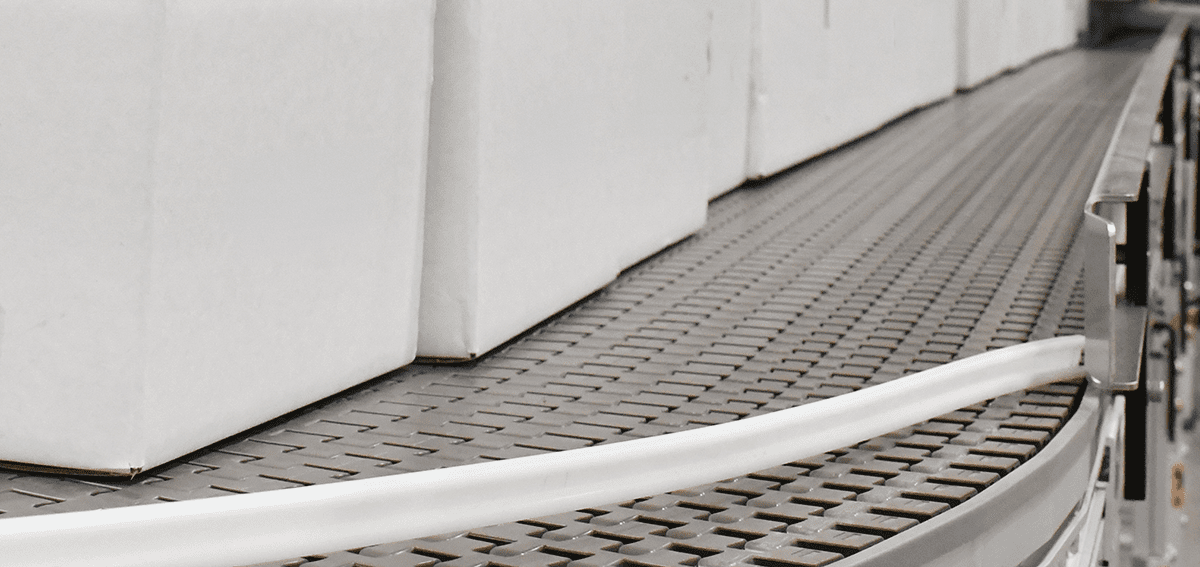
Modular Plastic Belt for Washdown Environments
In food and beverage packaging, modular plastic belt systems are the working alternative to rubber. Modular plastic belt systems are made of interlocking plastic modules snapped together, and they clean easily, resist corrosion, and meet USDA washdown standards. Vendor literature often claims 3x longer service life versus rubber in washdown applications (per manufacturer claims).
The trade-offs are in cost and speed. Modular plastic costs more upfront and runs slower than rubber. In dry environments, rubber belts are cheaper and faster, but in washdown, modular plastic earns the premium.
Powered Roller Conveyors
Best for: Buffering before equipment that pauses or cycles.
Avoid when: You only need simple movement from one point to another.
Common use: Buffering before palletizers, case packers, and robotic cells.
Powered roller conveyors are the right choice when your line needs buffering.
Unlike a belt conveyor, a powered roller system can be divided into independent zones. Each zone can stop or start on its own, allowing cases to queue without pushing into each other.
This matters when downstream equipment runs in cycles. For example, if a palletizer pauses, the conveyor keeps accepting cases from the case sealer and releases them when the palletizer is ready. The case sealer never has to stop, and that’s where the throughput gain comes from.
The trade-offs are that powered roller systems are more complex than belt systems due to things like chain tensioning and bearing wear. Powered roller systems are also slower (typically 60–180 feet per minute in packaging), they cost more, and field maintenance requires more skill than for a belt conveyor. But for accumulation-heavy applications, they’re often the only viable choice.
Pro Tip
In most powered roller systems, accumulation is controlled by zone-occupancy sensors and PLC logic that engage or disengage zone clutches. Two patterns are common: zero-pressure accumulation (zones stop before products touch) and low-pressure accumulation (zones allow gentle contact when full).
Specialty Conveyors
The different types of specialty conveyors each solve a specific constraint.
Slat Conveyors
Best for: Heavy cases, pallets, and irregular loads.
Avoid when: Small products or sanitary environments where gap-free is required.
Common use: Pallet-level movement to and from the warehouse.
A slat conveyor uses a heavy-duty chain with rigid slats (metal or plastic) attached. Products sit on the slats. The trade-off is the gaps between slats which can lead to small products dropping through. Maintenance and cost run higher than belt conveyors.
Spiral Conveyors
Best for: Vertical movement in limited floor space.
Avoid when: Standard horizontal runs.
Common use: Cold-storage retrofits and tight-footprint upgrades.
A spiral conveyor uses a continuous belt or chain in a compact helix to transport products between vertical levels. It is space-efficient, but significantly more expensive than a horizontal belt or roller, and it is more mechanically complex. Best practice is to specify when the space benefit justifies the cost.
Gravity Roller
Best for: Low-cost, short-distance movement.
Avoid when: You need speed control or automation.
Common use: Simple infeed, manual loading stations, low-volume transitions.
There is no motor used for a gravity roller. As its name implies, products simply roll downhill. This model is the lowest cost, lowest maintenance option, however, it does remove automation potential.
Chain and Magnetic
Chain conveyors handle heavy industrial loads, but they rarely fit food or beverage packaging because chains accumulate grime in the cracks. Magnetic conveyors move ferrous metal parts only. Since cases, cartons, bottles, and bags aren’t ferrous, magnetic conveyors rarely apply to end-of-line packaging.
Standards: Three Conversations to Have Before You Buy
Conveyor design lives inside a few standards that shape what you can specify.
- Safety → Does the conveyor meet ASME B20.1 (versions are updated every three years) and OSHA guarding requirements for pinch points?
- Maintenance → Are pinch points guarded? Is lockout/tagout designed in?
- Sanitation → If this involves food or beverage, does the design support 3-A Sanitary Standards (for washdown, drainage, cleanable surfaces, food-safe materials, etc.)? The USDA now accepts 3-A symbol authorization as proof of compliance, so equipment bearing the 3-A mark no longer requires separate USDA plant inspection.
The best practice is to have these three conversations before signing a quote. The safety and sanitation requirements in particular are what prevent the worst surprises later.
Five Pitfalls That Derail Conveyor Specifications
Here are the five pitfalls to be aware of when selecting your conveyor. Although each of these shows up regularly on real lines, they are also preventable.
Under-Buffering
What happens: Downstream equipment pauses, cases back up, and the full line stops.
Why it happens: The conveyor was sized for average flow, not real operating behavior.
How to prevent it: Specify accumulation when downstream equipment has variable cycle times.
Mismatched Speeds
What happens: Cases compress (on slow conveyors) or gaps open and downstream starves (with fast conveyors). Collisions damage product and jam equipment.
Why it happens: Conveyor speed wasn’t matched to adjacent equipment cycles.
How to prevent it: Specify every conveyor to match the cycle speed of upstream and downstream machines.
Poor Transfer Design
What happens: Products tip at transfer points and jam downstream equipment.
Why it happens: Transfers are angled, run across dead plates, or use sharp edges.
How to prevent it: Design transfers tangent (aligned, not angled). Use rounded edges and low-impact design. Test product orientation during line design.
Washdown Specification Error
What happens: Rubber belts absorb water and breed bacteria. Painted frames rust. Bearings corrode.
Why it happens: The conveyor was specified for dry, then installed where washdown is routine.
How to prevent it: Specify washdown-capable equipment upfront. Ensure it has USDA-compliant modular plastic belts, stainless steel frames, sealed motors, and drainage design.
Indexing Motor Burnout
What happens: A motor on a high-frequency indexing conveyor overheats and fails prematurely.
Why it happens: Single-phase AC motors aren’t rated for more than one stop/start cycle every three minutes, and high-cycle indexing routinely demands more.
How to prevent it: Specify a three-phase motor or a VFD with soft-start capability for any high-cycle indexing application.
A Simple Decision Tree
Use this simple flowchart to help identify what type of conveyor is best suited to your operation.
Do you need accumulation?
NO
YES
Powered roller conveyor
Is the product flat-bottomed and moving horizontally?
NO
YES
Belt conveyor
Is the environment washdown / hygienic?
NO
YES
Modular plastic belt conveyor + stainless construction
Are you moving heavy loads or pallets?
NO
YES
Slat or chain conveyor
Do you need vertical movement in limited floor space?
YES
Spiral conveyor
What to Do Next
Before you choose the conveyor type, define the conveyor’s job.
Are you simply moving product from one machine to another? If so, a belt conveyor may be enough. Are you buffering before a palletizer or case packer? In that case, you probably need powered roller accumulation. Are you dealing with washdown, heavy loads, vertical movement, or tight floor space? That’s where specialty conveyors come in.
Before you approve a quote, make sure the proposal explains the following specs. Any spec gap the proposal doesn’t close usually shows up six months later as a stoppage you didn’t budget for.
- The product → Weight, size, fragility, footprint, and orientation through the conveyor
- The downstream machine’s behavior → Continuous vs. cyclic, expected pauses, and buffering needs
- The environment → Dry, washdown, cold storage, or other constraints
- The accumulation strategy → Zero-pressure, low-pressure, or none at all
- Ownership of transfer points → Who owns the seams between this conveyor and the equipment on either side
With these details and guidelines, you’ll be off to a good start choosing the right conveyor for your end-of-line.
Not Sure Which Conveyor to Choose?
Give us a call. INSITE’s team of specialists are here to help you find the best-fit solutions.