At a Glance
Fully automatic case sealer cost runs between $50k and $90k at base price – it’s normal to see a range, because your operational needs can cause price to fluctuate. This cost is also driven by the following factors:
-
Tape vs. Glue
- Glue naturally increases sealer price, but price alone shouldn’t make your decision. Your volume should.
-
Build Quality
- Guarding and Safety – Know what your vendor is offering when they say “Guarding: Yes.”
- Machine Uptime – Lower-cost machines may prove to be more expensive due to greater wear parts.
Clarify what your vendor’s price includes. Also keep an eye out for how they’re quoting installation and integration costs – these factors are often not as costly as you’re made to believe. Keep these key drivers in mind, ask good questions, and sign with the vendor who’s going to deliver to your needs
Introduction
Picture this: you recently bought a case sealer, and the cases coming off it aren’t staying closed. The flaps pop open somewhere down the line. To catch those cases, you hire a few hands to hand-tape them shut, before returning the cases to the conveyor. The sealer runs – it just doesn’t do the one job asked of it.
How frustrating would that be? Very? Unfortunately, it’s a reality for one of our customers who’s currently running a glue sealer from a previous vendor.
If you’re only considering a quote at face-value, understanding case sealer price can seem easy. It’s much harder if you’re trying to ward off that reality for your operation.
Note: If you’re concerned that this reality will become your own, look for a vendor like INSITE, that offers a corrugate evaluation. This service is free for prospective customers. You send in your blanks, and we provide feedback about how we believe it will run on automated equipment. It’s a simple process that can provide some real certainty.
In this article, we’ll cover:
- What goes into a case sealer’s starting price
- The trade-off decision in tape vs. glue (plus a third option!)
- The factors that reveal a vendor’s build quality
- Where you might have extra funds allocated
- What the wrong vs. right decision looks like, and where to go from here
What Goes into the Starting Price Range?
A base automatic case sealer – tape-seal, limited options – typically runs $50,000-$60,000. Ask two sales members on the same team, and you’ll get both numbers. And that’s normal. This starting range reflects how great an impact a single choice (e.g. line speed, guarding package, control platform, etc.) can have on price. And that’s for tape-sealing only.
Add glue capacity to this sealer, and the range will bump up to $80,000-$90,000, at the higher end. That’s a big jump, and it illustrates an important point: you want to understand the variables going into your case sealer price, because small decisions make a big difference.
Still Stuck on the Price Range?
Here’s a new way to think about it: consider any hard quote as a starting point. Beyond base price, you’ll have conversations about what’s included (both mechanically and contractually), what costs are necessary for your operation, and what add-ons are optional. Don’t see this initial price as a fixed capital to compare.
1. The Sticky Tradeoff: Tape vs. Glue
One of the biggest cost drivers in case sealers is your choice of adhesive. Unexpected or not, tape and glue carry two very different cost structures. It’s easy to dismiss glue as the more initially expensive option, but the actual cost-saver depends on your line.
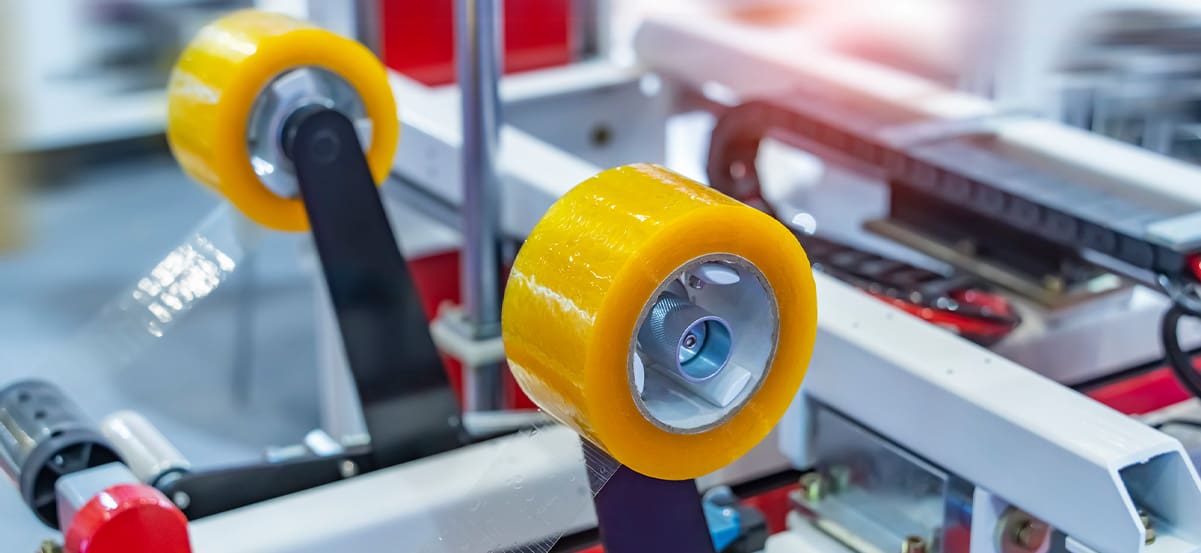
Tape
Upfront: Tape is the lower-cost option upfront. That’s pretty universal, across the board. It’s also simpler to get running on day one.
Long-Term: Tape rolls need restocking, and every time you change a roll, that’s a potential moment where the line can stop. Tape can become a liability for your uptime.
Glue
Upfront: Glue capabilities require a more expensive machine.
Long-Term: Glue is a less expensive consumable, and it allows your machine to run continuously. The glue tank can be refilled while the machine is running, rather than needing to completely pause to restock, mid-shift.
There isn’t a correct answer for every operation, all the time. A lower-volume operation, running intermittently, tends to do better with tape. The glue machine’s premium doesn’t pay for itself unless your throughput justifies. On the other hand, a higher-volume line, running continuously, sees real cost at every stop. That’s where glue’s price-gap begins to close.
The Middle Ground: A Glue-Ready Option
If you’re struggling with the tape vs. glue debate, there is a third option. A glue-ready machine, sometimes called a GT configuration, runs on tape, but can be upgraded to glue later. It avoids the upfront capital of a glue sealer, and wards off risk of premature replacement in a couple of years.
This can make a big difference for the operation whose volume isn’t at a steady low or high rate. Committing to glue too early may feel like unused capital, but committing to tape-only may backfire when you need glue capability in eighteen months. The GT configuration can be the comfort to accommodate for now, and plan for then.
There’s also the option of a full GT configuration, which allows easy change over between tape and glue, for the life of your machine. This can be a good option for customers like co-packers, who run recipes with both tape and glue.
Tape vs. glue is a pretty visible decision – maybe one you were already mulling over. The next driver is quieter, and it isn’t easily scoped before the machine is running. That driver is build quality. It’s the driver that targets the questions: How is the machine built? And, what does the build actually protect against?
This driver shows up in two main areas:
1. Guarding and Safety
Just like tape vs. glue, you’re looking at a tradeoff. A full-length guarding package – interlocked doors, fencing, marking, etc. – is a real cost item. On the other hand, lower-cost machines often leave mechanisms reachable, which means openness to injury. You’re weighing cost against workers’ safety.
The difference shows up like this: on an INSITE machine, opening a guard door to clear a jammed case, stops the machine. On some lower-cost alternatives, the machine continues running while someone reaches in to fix it. That’s a lot of liability running on a little spec sheet listing, “Guarding: Yes.”
2. Machine Uptime
The other factor of build quality may not be realized until well into the life of the machine. Cheaper machines hold more downtime risk. This means they have wear parts that are more likely to break down – more spare parts to stock, more in-house maintenance, so they keep running.
In relation to machine uptime, evaluate the quality of your vendor. Machines inevitably fail; so you want to make sure you have a vendor who acts like a partner, rather than just a supplier. This can make a real difference if your facility doesn’t have a wealth of technical staff and expertise to fall back on, during every equipment failure.
Where Extra Funds Might Be: Installation and Integration Costs
A lot of buying guides will point to installation and integration costs being the big hidden items to watch for. We’ll be a bit disruptive here: a case sealer really doesn’t have all that much dependency on the rest of your line.
Your main concern in this area should be conveyor height, and most machines have a wide adjustment range built in to handle that. If a quote is loading extra cost into “integration complexity,” that’s worth asking about directly. Especially if you’re purchasing a standalone case sealer.
Seal Type
Base Price
With Full Guarding
With Installation & Integration
Total (with Both Add-Ons)
Tape-Seal Only
Autopopulated Label (Mobile Only)
$50k – $60k
Autopopulated Label (Mobile Only)
$54k – $64k
Autopopulated Label (Mobile Only)
$53k – $63k
Autopopulated Label (Mobile Only)
$58k – $68k
Glue-Seal Only
Autopopulated Label (Mobile Only)
$80k – $90k
Autopopulated Label (Mobile Only)
$68k – $70k
Autopopulated Label (Mobile Only)
$68k – $78k
Autopopulated Label (Mobile Only)
$71k – $81k
GT Glue-Ready
Autopopulated Label (Mobile Only)
$59k – $69k
Autopopulated Label (Mobile Only)
$63k – $73k
Autopopulated Label (Mobile Only)
$62k – $72k
Autopopulated Label (Mobile Only)
$66k – $76k
GT Full
Autopopulated Label (Mobile Only)
$74k – $80k
Autopopulated Label (Mobile Only)
$78k – $84k
Autopopulated Label (Mobile Only)
$77k – $83k
Autopopulated Label (Mobile Only)
$81k – $87k
Note: Our table is built for beginning budgeting purposes. All of these ranges can shift depending on vendor and operational needs. Our ranges are based on speed with a low end of 20 CPM and an upper end of 30 CPM – and they aim for general market pricing.
What Happens If I Make the Wrong Decision?
Okay, the stakes. What happens when this decision goes wrong? Think back to our example at the beginning — our customer having to hand-tape cases because their previous vendor’s sealer didn’t finish the job. That’s the cost of getting this wrong.
You’ll be hand-taping cases while your case sealer continues to output cases that aren’t up to par. The quote may look fine, but the floor will say otherwise.
What Happens If I Make the Right Decision?
Now here’s the good part: what happens when you get the decision right? You have a machine near-perfectly matched for your actual volume, your actual team, and your actual budget. The machine is high quality, safe, and leaves room for your operation to grow.
And if you find the vendor who’s going to deliver to your needs, the machine on your floor a year from now will be the one you received the quote for on day one. No surprise integration costs, no unclear guarding specifications, and no hand-taping.
Curious About INSITE Case Sealers?
Give us a call. INSITE’s team of specialists can answer questions and discuss automation options and prices.