Introduction
At a Glance
How do you stabilize a pallet? Three factors contribute to pallet stability: stacking pattern, containment, and load profile or cube. Only one part of overall stability, stretch wrap often gets the blame when things go wrong. But the key is to find the balance between all three factors. Here’s what each factor contributes to the whole load:
- Stack Pattern:
-
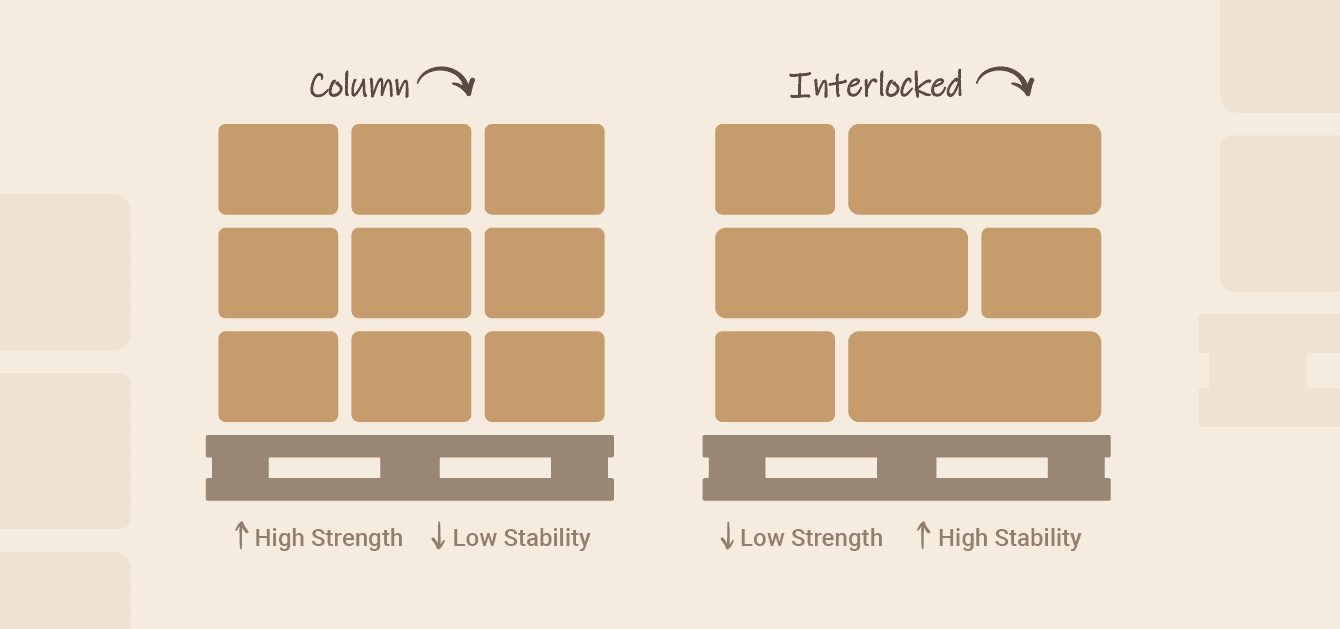
Column Stacking – When cases are stacked corner-to-corner, one on top of another. High in strength, weak in stability.
-
Interlocked Stacking – When cases are stacked in an alternating pattern from layer to layer (like bricks). High in stability, weak in strength.
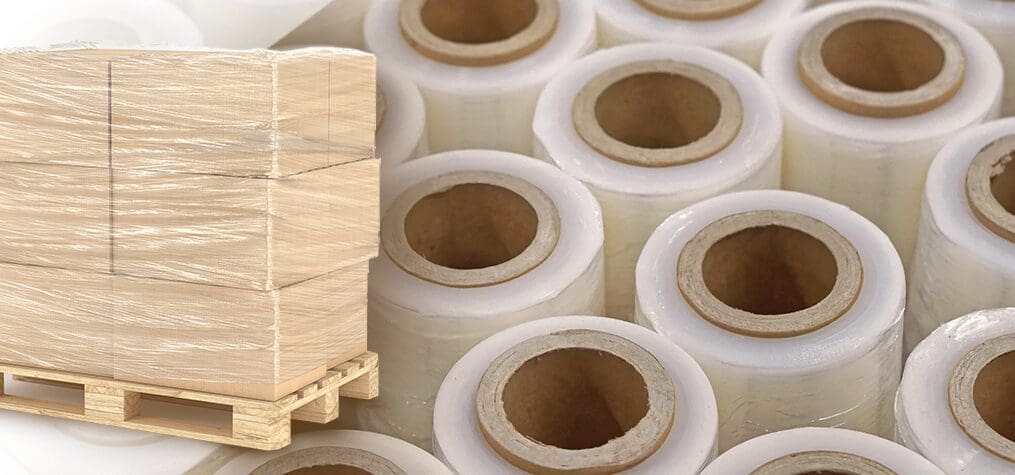
- Containment: holds the load together; stretch wrapping is the common method, and some operations include strapping or a top sheet to help stabilize.
- Cube: how the cases fill the pallet footprint and how tall the load runs. Cube is part of how high freight costs end up. It’s tempting to overhang to save on space but that compromises stability.
Toppling cases, crushed corners, and damaged product are all realities of palletizing. It’s easy to blame the stretch wrapping when things go wrong, but it’s often upstream where instability arises. Stack pattern, containment, and cube all contribute to how well your pallet stays intact during transit.
Improving pallet stability is a challenge, but it’s not impossible. It has to do with the right balance of the three key factors for the specific product.
In this article, we’ll cover:
- How stability is a product of the whole load
- How stacking pattern methods trade stability vs. strength
- What role containment plays
- The impact of cube efficiency
- How to recognize and fix instability issues
What Promotes Stability? The Whole Load
The key to a load behaving like a single structure is building it like one. The stretch wrap, alone, doesn’t make or break the integrity of the whole load. The wrap applies inward holding force, but can’t create stacking strength, square up a leaning column, or compensate for overhang.
Many operations overwrap loads that still fail. This is only adding film to a structural problem. It costs additional material without fixing the root issue. A more useful way to think about stability accounts for each factor like this:
- Pattern and Cases – the stack pattern and cases provide the structure and strength
- Containment – the containment (which includes stretch wrap) turns the structure into a moveable unit
- Cube – the cube determines how much you’re paying for freight
Stack Patterns: Column and Interlocked Stacking
The biggest impact to integrity is pattern, or case arrangement. Operations must choose between two stacking strategies:
- Column Stacking – High on strength, weak on stability
Cases are placed directly on top of one another, corner over corner. Column stacking provides the best stacking strength, as corrugated cases carry most of their compression strength in their vertical edges. However, column stacking has no interlocking between layers, so columns can compromise under a side load or hard stop. - Interlocked (Brick) Stacking – High on stability, weak on strength
Cases are rotated between layers, so they overlap. This ties the layers together. The overlap makes the load far more resistant to shifting and shedding layers. But just like column stacking, interlocked stacking has its own cost: cases are no longer stacked edge-on-edge, so the load loses stacking strength.

Neither method is universally right. Tall, heavy loads that need stacking strength may lean toward column stacking with the addition of strong containment. On the other hand, loads that see rough handling or long transit, will often opt for interlocking. A capable palletizer can make a lot of difference here. The pattern only helps if it’s executed consistently, and sometimes this makes the machine investment worth it.
Containment: Holding the Load Together
The second factor, containment, is what converts a stack into one unit that moves as a whole. Stretch wrap is often what’s used, with variations made in applied holding force and thickness. Some operations will add additional wrap patterns based on need:
- Strapping – adds vertical or horizontal tension for heavy or rigid loads
- Top Sheet – shields against dust and moisture, and helps lock the top layers (which are usually the first to shift)

Containment is a necessary and helpful aspect of pallet stability. It’s where film and equipment choices pay off, but it’s all dependent on the structure that is underneath it. For good structures, it holds beautifully; for bad structures, it really only holds until the first real disturbance.
Load Profile or Cube: Freight Costs vs. Load Integrity
Cube efficiency refers to how completely the load fills the pallet footprint and shipping container. Freight is often priced by space. Denser, better-cubed loads ship more product per truck, and lower overall delivery cost per unit.
The tension comes in when the loads that maximize cube undermine stability. Overhang is when cases are extended past the pallet edge to squeeze in more product. It provides a clear example: a case that hangs even an inch past the edge can lose a lot of compression strength. The unsupported corner is exactly where the case is the strongest.
Running loads taller to fill the trailer raises the center of gravity and makes toppling more likely. Underhang wastes cube space but is structurally safer. Overhang maximizes cube space, but at the cost of stability and strength.
Pro Tip
Cube and stability pull in opposite directions at the extremes. You don’t have to choose efficiency in one or the other. The goal is in the balance: fill the pallet footprint clearly, keep the load square to the edges, and take the height only as far as the pattern and containment allow.
How to Recognize and Fix an Unstable Load
Instability can be recognizable, and may point to a logical fix:
Why
To Fix
Leaning Load
Autopopulated Label (Mobile Only)
Cases were placed out-of-square or in an uneven pattern.
Autopopulated Label (Mobile Only)
Evaluate palletizer placement accuracy and pattern consistency (upstream of the stretch wrapper).
Layer Shift or Shedding
Autopopulated Label (Mobile Only)
Column stacking was done with insufficient interlock or containment.
Autopopulated Label (Mobile Only)
Introduce interlock or increase containment force on the affected layers.
Crushed Corners/Leaning Columns Under Weight
Autopopulated Label (Mobile Only)
Overhang or interlock patterns were done on a load that needed stacking strength.
Autopopulated Label (Mobile Only)
Eliminate overhang, and reconsider column stacking with stronger containment.
Slipping Top Layers
Autopopulated Label (Mobile Only)
No downward containment on the top.
Autopopulated Label (Mobile Only)
Use a top-sheet or top-load wrap.
The key question to ask yourself is where and how the load fails. Failures often point to the weakest factor: pattern, containment, or cube.
To Avoid Common Traps, Look Upstream First
When a load is unstable, the stretch wrapper is usually the wrong place to start. Adding wraps or heavier film to leans or overhangs, only treats the symptom. It raises material cost without making the load sound. Chasing maximum cube is another common trap.
Often, the real fix is upstream:
- A squarer, more consistent pattern from the palletizer
- Eliminating overhang
- Switching between column and interlock stacking
- Improving case quality and squareness
Wrapping is a great asset to keep loads together, but it can only be effective if the load is well-built in the first place.
Build for Stability
A truly stable pallet balances all three factors for the specific product:
- Pattern that fits the load’s strength vs. stability needs
- Containment adequate to the force the load requires
- Cube that fills the footprint without sacrificing integrity
A load built this way arrives the way it left. And the palletizer, stretch wrapper, and freight bill all do their jobs instead of fighting against each other.
Looking for More Stable Palletizing?
Give us a call. INSITE’s team of specialists can answer questions and discuss automation options.