Introduction
At a Glance
Tape selection for a case erector or sealer comes down to six decision factors.
- Width — Your tape head determines whether you need 2-inch or 3-inch
- Thickness (gauge) — Most carton-sealing tape runs 1.5 to 3 mil. Thinner is cheaper per roll but is the leading source of breakage on automated lines.
- Adhesive quality — Bad adhesive fails two ways: bond strength (cases open) or residue (transfers to the blade and rollers, dulls the blade over time).
- Climate fit — Cold environments kill tack; humid environments make corrugated absorb moisture. Reputable manufacturers offer climate-specific formulations for both.
- Line speed rating — Every tape has a maximum safe peel rate. Thinner tape breaks first at high line speeds. Confirm the spec matches your machine’s feet-per-minute rating.
- Supplier consistency — Established commercial tape manufacturers earn the spec slot because their specs are repeatable lot to lot. Brand alone isn’t the value; predictable specification is.
Aligning these specs with your operation makes the line runs through the year, while getting them wrong can cost hours and potentially thousands of dollars in misdiagnosed issues.
In this article, we’ll cover:
- Why tape problems are routinely misdiagnosed as machine problems
- The six selection factors, with the trade-offs each one creates
- How adhesive quality affects both case integrity and machine wear
- Why climate-specific formulations are worth ordering for non-standard environments
- One operational best practice that turns a five-minute roll change into a thirty-second one
Tape Problems Look Like Machine Problems Until Someone Checks the Roll
When a packaging line starts producing intermittent faults, tape is often the last item anyone considers. Jammed cases, partially sealed flaps, or unsealed boxes moving downstream can lead to operations spending hours adjusting machine settings, reviewing fault logs, and troubleshooting what appears to be an equipment issue. In some cases, a field service technician gets called onsite. In the end, what could have been a quick and inexpensive tape fix has ended up costing several thousand dollars between travel, time, and accumulated downtime.
The six factors below won’t prevent every tape problem. Things like corrugated quality, cold or humid environments, and machine state all matter too. However, these six factors could help save you a service-visit fee to address what you could fix with a simple visit to the supply closet.
1. Width
Tape for case erectors and sealers typically comes in two widths: 2-inch and 3-inch. Your tape head determines which width you need.
This sounds obvious, but it’s the first place a spec error shows up. A roll that’s the wrong width either doesn’t track properly through the rollers or doesn’t deliver enough sealing surface to hold the case closed under stacking weight. To avoid issues, confirm the width against the machine’s tape-head specification before ordering. If your facility runs multiple sealers, confirm each one as they may not all use the same width.
2. Thickness (Gauge)
Most carton-sealing tape falls between 1.5 mil and 3 mil. Thinner tape is cheaper per roll and holds more footage per reel, which means less frequent roll changes and a lower per-roll unit cost. However, thinner tape is also a leading source of breakage, and the savings on the consumable typically doesn’t outweigh the downtime it causes.
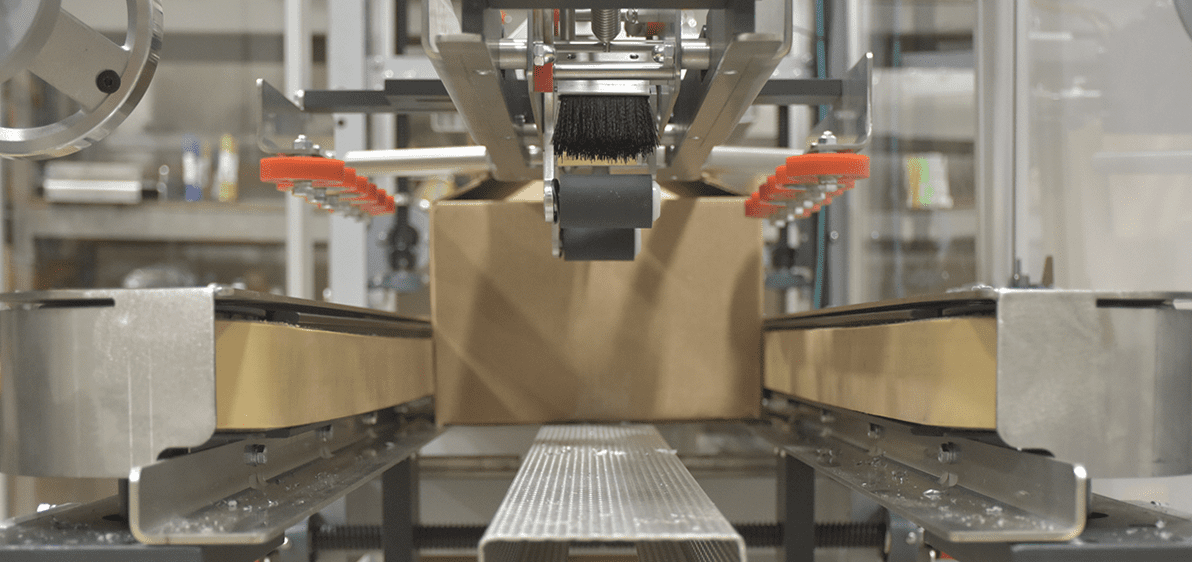
The issue works like this: The tape head feeds tape toward each moving case by inducing a slight curl, and that curl gives the tape the rigidity it needs to reach the case and seal across the seam before the box passes the application point. Thinner tape can’t hold that curl as reliably. When the curl collapses, the result is a partial seal, the machine faulting, and the operator spending 5+ minutes re-threading the tape head. Multiply that by how often it happens per shift and the cheap tape can start looking expensive.
However, the trade-off isn’t categorical. There are good reasons to run 1.5 mil tape on lines where it works, but it’s important to make the choice deliberately while knowing the failure mode.
3. Adhesive Quality
When it comes to adhesive quality, there are two possible failure modes. The first is bad bond strength, which results in cases opening after they’ve been sealed. A seal can look fine when it leaves the line, but somewhere in stacking, shipping, or warehousing, the flaps can separate, leading to product loss, rework, and customer-quality complaints.
The second failure mode happens when adhesive doesn’t release cleanly, and this issue is worse for the machine. Adhesive that doesn’t release cleanly transfers to the cutting blade and the rollers in the tape head. It builds up over time, dulls the blade, and slows the application. A felt pad coated with mineral oil sits on the tape path on most machines to slow that accumulation, but it’s a maintenance step fighting a losing battle when the adhesive formulation is poor to begin with.
Both failure modes can be traced back to the same upstream choice: ordering a tape with adhesive that wasn’t specified for the line’s application. Lower-spec adhesives that work in static applications (sealing a hand-packed case) don’t survive automated application where the tape head is pulling the roll through multiple roller transitions per second.
4. Climate Fit
Tape behaves differently in different environments, and the standard formulation that works fine in a climate-controlled warehouse doesn’t necessarily work in cold storage, frozen-food packaging, or a humid plant.
Cold kills tack. When operating below the tape’s rated temperature, the adhesive doesn’t grab the corrugated surface the way it does at room temperature. The case may seal at the machine only to fail later in the cold chain. If you’re running tape on a line that feeds a freezer or cold-storage facility, that environment is an important specification input.
Humidity affects the corrugated as much as the tape. Cardboard absorbs moisture in humid environments and gets softer, providing less surface for the tape to bond to. The combination of standard-formula tape and damp corrugated is one of the more common sources of failed seals in plants that don’t run climate-controlled.
Most reputable commercial tape manufacturers produce climate-specific formulations for these exact two conditions. Cold-environment tapes have adhesives rated for sub-freezing application, and high-humidity tapes have stronger initial tack. If your facility runs cold or damp, request those specs rather than going with the standard formulation on a parts order.
5. Line Speed Rating
Every tape has a maximum safe peel rate. This is the speed at which the tape can be pulled from the roll and applied before the bond weakens or before the tape itself starts to fail under the application stress. That ceiling drops as thickness decreases.
At high line speeds, thinner tape often breaks. The same roll that runs cleanly at 30 cases per minute (cpm) may produce intermittent failures at 60cpm.
When working on the spec sheet, confirm that the tape you’re ordering is rated for your machine’s feet-per-minute rating, including the surge speeds you run during peak production windows. A tape that is spec’d for the average line speed but not the surge speed will produce its failures right when downtime costs the most.
6. Supplier Consistency
When evaluating commercial tape manufacturers, keep in mind that the value doesn’t come from the brand label. It comes from specification consistency. When specifications are repeatable lot to lot, it means the roll that ships in March is the same gauge, adhesive formulation, and peel rating as the roll that shipped in October. That predictability is what lets your line run without fault-chasing.
We’ve seen plenty of lines where someone switched suppliers to save a few cents per roll, didn’t ask for the spec sheet, and started seeing intermittent breakage two weeks later. Although the new tape’s gauge was nominally the same, the actual adhesive formulation and peel-rate rating were not.
Every INSITE case erector and sealer ships running tape that has been spec’d against the machine. The breakage problems on those machines almost always start after someone switched to a cheaper roll without comparing the underlying specs. If this happens to you, ask your supplier for the spec sheet on any candidate tape before you order it, and compare it line by line against what’s currently running cleanly.
To summarize, it doesn’t matter what brand of tape you choose. What matters is that the specs match exactly what your line requires every time you order a new supply.
Best Practice: Stage a Pre-Loaded Tape Head
Roll changes are inevitable. The operations that handle them fastest keep a spare tape head staged and pre-loaded so the operator can swap the head, restart the line, and reload the spent one at their own pace. A five-minute stoppage becomes a thirty-second swap.
This is the kind of operational tweak that doesn’t show up in the tape spec but has a meaningful effect on annualized line uptime. If your line runs more than a few rolls per shift, the spare-head workflow is worth setting up.
Where to Start If You’re Having Tape Problems
Tape problems are rarely isolated issues. They’re usually the intersection of a consumable, a machine, and an environment—and the right solution depends on understanding all three.
Before you call a service technician, work through this short checklist:
Did the problems start after a tape change?
If yes, the new roll’s spec is the place to look first. Compare the spec sheet against what was running before.
Did the environment change?
E.g., A line that moved from indoor staging to a refrigerated zone needs a re-spec.
Did the line speed change?
A surge-speed configuration that wasn’t part of the original spec call may have crossed the tape’s safe peel-rate ceiling.
Has anyone touched the tape head’s tension settings recently?
A roller adjusted while troubleshooting something else and left in a tighter position is one of the most common causes of breakage.
If those four questions don’t help you surface the answer, that’s when a service call is the right step. By then, you’ll have the diagnostic information the technician needs to resolve it on the first visit.
Experiencing Tape Issues?
Give us a call. INSITE’s team of specialists are here to help pinpoint the issues and find their solutions.