Introduction
Manual pallet stacking is one of the most physically demanding and injury-prone tasks at the end of a packaging line. Here is a plain-language explanation of how palletizers work, the difference between conventional and robotic systems, how pallet patterns affect load stability, and the signals that indicate it is time to evaluate automation.
What Is a Palletizer?
A palletizer is a machine that receives products from the end of a packaging line and stacks them onto a pallet in a defined layer pattern, automatically and consistently.
Palletizers sit downstream of case sealing and upstream of stretch wrapping. They are typically the last piece of automation before a pallet moves to staging, storage, or shipping.
The machine receives cases, trays, bags, or bundles from an infeed conveyor, builds each layer according to the programmed pattern, stacks layers to the target height or weight, then discharges the completed pallet. An empty pallet is moved into position and the cycle begins again.
Why Automate Palletizing?
Manual palletizing creates four categories of operational risk that compound as line speed and volume grow:
- Injury and Ergonomic Exposure: Repetitive heavy lifting combined with the awkward postures required to reach the top of a growing pallet stack is a well-documented source of musculoskeletal injuries. The heavier the case weight and the faster the line, the greater the exposure per shift.
- Labor Cost and Turnover: Palletizing is physically demanding, which makes it hard to staff consistently and produces above-average turnover. The costs of recruiting, onboarding, and productivity loss accumulate with each replacement.
- Throughput Ceiling: Manual palletizing has a natural speed limit. As line speed increases, more people are required to keep pace until the task becomes impractical to staff at the required rate. An automated palletizer removes that ceiling.
- Inconsistent Pallet Quality: Hand stacking produces variable results such as off-pattern layers, inconsistent pallet heights, and unstable loads. Poor load quality leads to product damage in transit and rejected pallets at distribution centers. A machine builds the same pattern every cycle.
The Two Main Categories: Conventional and Robotic
Palletizers come in two fundamental categories. While both automate the stacking process, they differ in how layers are formed, their flexibility across SKUs and patterns, and where each makes practical sense.
Conventional Palletizers
Conventional palletizers use mechanical systems—typically sweep arms, layer-forming plates, and lift tables—to build pallet loads one full layer at a time. Product is collated into a complete layer on a staging surface and then transferred to the pallet as a unit. There is no robot arm.
Conventional palletizers are classified as high-level or low-level based on where product enters the machine. High-level palletizers receive product via an elevated infeed conveyor, above the height of a finished pallet. The pallet is raised to meet each new layer as the load is built. High-level systems can handle 30 to 60 or more cases per minute, making them the choice for high-speed, high-volume lines.
Low-level palletizers run from a floor-level conveyor. They are simpler in construction, have a smaller footprint, and are generally less expensive than high-level systems. They can often be installed at an existing manual palletizing station without major disruption to the surrounding line. Typical throughput ranges from 10 to 30 cases per minute. For operations making the transition from manual to automated palletizing for the first time, low-level conventional systems are a practical and proven starting point.
The main limitation of conventional palletizers is pattern and format flexibility. They handle square and rectangular secondary packaging well, but changing case size or pallet pattern typically requires more setup time than a robotic system.
Robotic Palletizers
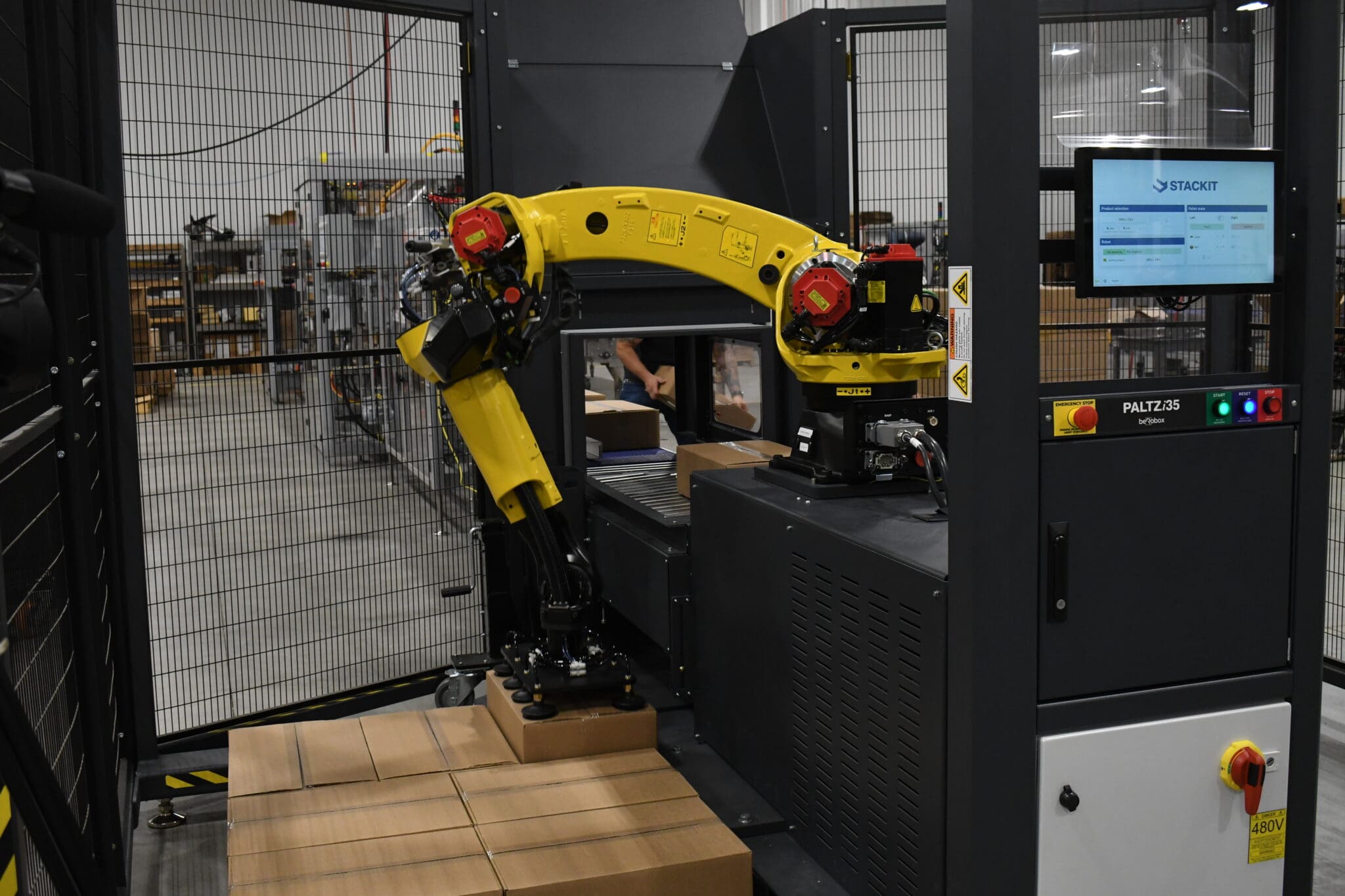
A robotic palletizer uses an articulated robot arm fitted with a custom end-of-arm gripper. The arm picks cases from the infeed, orients them as needed, and places them onto the pallet one case or one row at a time according to a programmed stacking pattern.
The primary advantage is flexibility. Changing the pallet pattern or accommodating a different case size means updating the software, not retooling the machine. Robotic systems store many patterns and can switch between them via recipe selection on an HMI. A single cell can also handle a wider variety of packaging types than a conventional system, including bags, pails, and trays alongside standard cases.
There are, however, a few tradeoffs. Robotic palletizers carry a higher capital cost than comparable conventional systems; they are more sensitive to dimensional inconsistency in cases (overfilled or humidity-distorted cases can cause placement faults); and at the individual-pick level, they are not as fast as high-speed conventional systems. Multiple robot arms on a single line can address throughput requirements where needed.
Cobot Palletizers
Collaborative robot (cobot) palletizers are designed to operate near people without full safety fencing, using built-in force sensing and safety systems to detect human presence and respond accordingly. They are lower cost, have a compact footprint, and use simplified programming interfaces.
Cobots have some practical constraints: Their payload capacity is typically around 20 kg per pick, and their sustained throughput generally tops out below 10 cases per minute. For lighter products at moderate speeds, cobots are a viable and cost-effective entry point. For heavier cases or faster lines, a full industrial robotic palletizer is the more appropriate choice.
Pro Tip
If palletizing is a full-time task for even one person per shift, it’s worth calculating the full annual labor cost at that station (wages, benefits, overtime, and turnover costs) and comparing it to the annualized cost of an automated system. For many operations, the payback period is shorter than expected, particularly when factoring in the injury history or high turnover at that station.
Pallet Patterns: What They Are and Why They Matter
A pallet pattern is the arrangement of cases on each layer of a pallet. It includes the number of cases per layer, their orientation, and how each layer relates to the one below it. Pattern selection directly affects load stability during transit, trailer space utilization, and compliance with retailer or DC receiving requirements.
The four most common patterns are:
- Column Stacking: Every layer is identical, with cases stacked directly above the cases below. Column stacking is simple to program and produces fast cycle times because the robot or sweep arm repeats the same motions on every layer. Load stability relies entirely on stretch wrap since the layers do not interlock. This method is well suited for operations where throughput is the priority and case weights are consistent.
- Interlocking (Brick) Pattern: Cases alternate direction between layers, similar to the offset rows of a brick wall. Interlocking creates a mechanically stable structure that resists lateral shifting during transit. This is the most common pattern for operations where load integrity over long-distance shipping is the priority. Robotic systems require separate placement coordinates for alternating layers, adding programming complexity but producing a significantly more stable load.
- Pinwheel Pattern: Cases are arranged at 90-degree angles in a repeating rotational sequence within each layer, creating a highly interlocked structure with small gaps at the center. This method offers high stability and is particularly useful when case dimensions do not divide evenly into the standard pallet footprint, since the rotational arrangement fills space more efficiently than row-and-column layouts.
- Hybrid Patterns: Combinations of the above, such as alternating column and interlocked layers, can balance the speed advantages of column stacking with the stability benefits of interlocking. Modern palletizing software can generate and optimize these patterns automatically based on case dimensions, pallet size, and weight targets.
Many retailers and distribution centers specify required pallet dimensions, patterns, and height limits for incoming product. A recipe-driven palletizer makes it straightforward to store and recall different customer requirements across the same line.
Other Considerations When Evaluating a Palletizer
Case Characteristics
Case weight determines whether a cobot or industrial robot is the right tool. Case dimensional consistency matters for robotic systems, which rely on cases arriving within a defined tolerance. Cases that are regularly overfilled, underfilled, or distorted by humidity create placement faults and reduce uptime on robotic systems.
Floor Space and Facility Constraints
High-level conventional palletizers require vertical clearance for the elevated infeed structure and may require platforms or catwalks for maintenance access. Low-level palletizers have a more compact footprint and can often install at the existing manual palletizing station. A typical robotic palletizer cell, including the robot arm, infeed conveyor, pallet staging areas, and required safety guarding, runs roughly 15 to 25 feet on a side, depending on configuration. Facilities with ceiling height restrictions or tight floor plans generally find low-level conventional or robotic systems the easier integration path.
Safety Guarding
Industrial robotic palletizers require a defined safety perimeter, typically physical fencing combined with light curtains or area scanners, because the robot arm operates at speeds and forces that are not safe for incidental human contact. This guarding is code-required, not optional, and adds to both footprint and installation cost. Cobot palletizers are designed to operate with reduced or no guarding in lower-risk configurations, though a risk assessment is always required regardless of the platform.
Changeover
For operations running multiple SKUs with different case sizes or pallet configurations, changeover flexibility is a meaningful factor in total cost of ownership. Recipe-driven robotic systems switch between stored pallet patterns quickly via HMI. Conventional palletizers are less flexible and significant case size changes may require physical adjustments. The long-term changeover cost and downtime of a less flexible system should factor into any cost comparison that goes beyond capital price.
Is a Palletizer Right for Your Operation?
A palletizer is typically worth a serious evaluation when one or more of the following apply:
- Someone’s primary job per shift is hand-stacking pallets, making that labor cost a direct automation target
- Case weights are high enough that palletizing creates meaningful ergonomic exposure for the team
- Line speed is at or near what the team can comfortably palletize manually
- Pallet quality is inconsistent with unstable loads, off-pattern stacks, or rejected pallets at customer DCs
- Throughput is planned to increase and palletizing will become the new bottleneck
If two or more of those conditions are true today, the conversation is worth starting even if the purchase is 12 months out. Understanding the options and the cost now means you are ready to move when the timing is right.
What’s Next
A palletizer is the last step in end-of-line automation before a pallet ships. Understanding how sealing and stretch wrapping fit on either side can help complete the picture. For just the basics, try starting with “What Is a Case Sealer and What Are Your Options?” and “What Is Stretch Wrapping and Where Does It Fit in End-of-Line?”
Want to Learn More?
Talk to the INSITE team about your line speed, case weights, and current palletizing setup. We’ll give you a straight read on whether automation makes sense for where you are.