Introduction
If you’ve started comparing fully automated case erectors, you’ve likely noticed something frustrating: Machines that “erect cases” can differ in price by two or three times.
That spread isn’t random, and it’s not just brand markup.
This article is written for buyers who are past the “should we automate?” stage and are now trying to understand why quotes vary so widely for machines that appear similar on paper.
The goal is to understand what you’re actually paying for and why seemingly similar machines are not equivalent.
It explains why case erectors are priced differently, focusing specifically on design choices, technologies, and performance expectations that drive equipment cost. It does not address installation, labor modeling, ROI, or total system budgeting. Those topics matter, but they belong later in the decision process.
The goal here is simpler and more foundational. It’s to help you understand what you’re actually paying for and why seemingly similar machines are not equivalent.
Pricing Starts with Design Intent, Not Feature Lists
A case erector’s price reflects the assumptions its designer made about:
-
How fast it must run sustainably
-
How often it will change formats
-
How variable the corrugate wil be
-
How much intervention operators and maintenance should provide
-
How tightly downstream equipment depends on case quality
Two machines can share similar specs on paper and yet behave very differently on the plant floor. This is because their differences lie in their design intent.
11 Key Drivers That Affect Case Erector Price
1. Speed and Throughput Capability
Cases per minute (CPM) is the largest single drive of price—but not for the reason most buyers assume.
Running faster doesn’t just mean cycling quicker. It requires:
-
Stiffer frames to resist vibration
-
Tighter timing between forming, folding, and sealing
-
More precise motion control to maintain squareness
-
Better tolerance of inconsistent corrugate at speed
Entry-level automation (~10-15 CPM) can often achieve rated speeds intermittently.
Higher-priced machines are designed to hold speed continuously, across shifts, operators and material variation.
Key Takeaway
You’re not paying for peak speed—you’re paying for repeatability under stress.
2. A Simple, Thoughtful ‘Theory of Operation’
It’s easy to build a case erector by solving problems one stage at a time, adding flights, stops, cylinders, sensors, and handoffs until each function works in isolation.
Designing a simple machine is much harder.
There’s a well-known idea, often attributed to Oliver Wendell Holmes, that captures this difference: “I wouldn’t give fig for the simplicity on this side of complexity; but I would give my life for the simplicity on the far side of complexity.”
In case erectors, that “far side of complexity” shows up in the machine’s theory of operation—the logic that governs how the case is handled from open, to fold, to square.
Higher-priced machines tend to reflect this philosophy by:
-
Minimizing stages, flights, and mechanical handoffs
-
Maintaining positive control of the case through the entire forming sequence
-
Replacing chains of mechanical events with coordinated servo motion or robotics
This approach often uses fewer total components, even though the components themselves are more capable.
A small number of servo axes or a robotic arm can replace dozens of mechanical parts, adjustments, and wear points. The price difference isn’t just about more expensive technology—it reflects the effort to collapse complexity rather than add to it.
Key Takeaway
True simplicity usually comes from replacing many low-cost interactions with fewer, more reliable ones.
The practical result is a machine that’s easier to operate, easier to maintain, and more tolerant of variation, because there’s simply less to manage, adjust, and keep aligned.
You’re not paying for complexity. You’re paying for a cleaner, more disciplined way of achieving the same outcome.
3. Base Machine Definition vs. “Optioned” Capability
One often-overlooked driver of price is what the manufacturer considers part of the base machine.
At first glance, two case erectors may appear similarly priced—until one quote starts to grow through options. The difference usually isn’t what the machine can do, but whether that capability is fundamental to the design or added later to make the machine whole.
Some machines are priced lower because the base unit is intentionally minimal. It erects cases but relies on optional add-ons to achieve the performance, safety, and usability most buyers assume are standard.
Other machines cost more because the base configuration already includes much of what’s required to be a fully functional, production-ready system.
Examples of capabilities that are sometimes treated as options rather than fundamentals include:
-
UL-listed electrical components and panels
-
Important safety architecture (like Category 3 vs something less)
-
Electronic or controlled case squaring
-
HMI-based recipe creation and management
-
Diagnostics, fault history, and guided troubleshooting
None of these features necessarily change what the machine does. Rather, they change how reliably, safely, and repeatably the machine does things in daily operation.
Key Takeaway
Some machines are less expensive because manufacturers assume you’ll finish building the solution through added options. Others cost more because that work is already done in the base design.
4. Case Ranges and Changeover Architecture
Supporting more box sizes and styles may increase cost, but how the machine changes over matters more than how wide the range is.
Price increases with:
-
Additional adjustment points
-
Motorized vs. manual positioning
-
Feedback devices to hold settings accurately
-
Software and commissioning effort for recipe management
In addition to size range, case style capability also influences price.
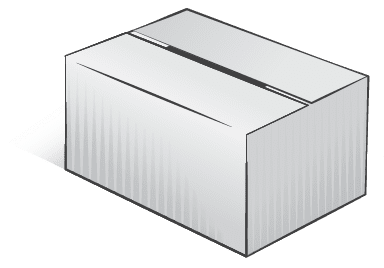
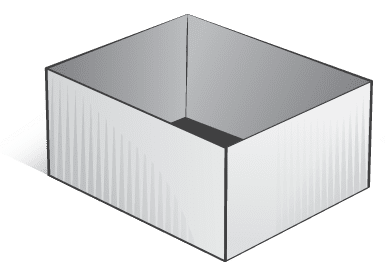
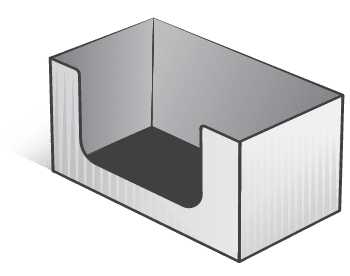
RSC
(Regular Slotted Case)
HSC
(Half Slotted Case)
Display Tray
Most fully automated case erectors are designed around RSCs (regular slotted cases). Machines that can also reliably handle HSCs (half slotted cases) or display trays must accommodate different case geometries and structure—not just different dimensions.
That typically requires:
-
Additional or reconfigurable forming motions
-
More sophisticated sensing or control logic
-
Tighter coordination to maintain squareness across styles
Manual and tool-less systems rely on operator consistency to manage both size and style changes.
Servo-driven, recipe-based systems embed those differences into the machine through control architecture and validated motion profiles.
Key Takeaway
You’re choosing whether flexibility—across both case size and case style—lives in the operator, the machine, or not at all.
5. Case Opening, Folding, and Squaring Technology
This is one of the most underappreciated pricing drivers.
Higher-cost machines invest in:
-
Positive case opening (vacuum or mechanical fingers)
-
Controlled minor flap tucking
-
Sequenced major flap forming
-
Compression or squaring sections that lock geometry before sealing
These systems require:
-
More axes of motion
-
More sensors
-
Tighter synchronization
-
More rigid structures
Key Takeaway
Poor squareness rarely fails at the erector—it fails downstream, where recovery is slower and more disruptive.
Machines designed to protect downstream performance cosst more because they assume the erector is structural to line stability, not just an upstream accessory.
6. Tape vs. Hot Melt Sealing Systems
Sealing method affects price primarily through integration complexity, not consumables.
Tape systems are:
-
Mechanically simpler
-
Lower in component count
-
Faster to commission
-
More resource-demanding at high speeds
Hot melt systems add:
-
Melters, hoses, and applicators
-
Temperature control and safety circuits
-
Pattern control logic
-
Additional failure modes that must be engineered out
-
Less disruption at high speeds
-
An arguably better seal
Advanced glue systems (stitching, variable patterns, tankless melters) increase price further due to controls integration and validation, going beyond just hardware.
Key Takeaway
This is mostly a technology and hassle-at-high-speeds decision, not a preference toggle.
7. Servo-Driven vs. Pneumatic Architecture
Motion philosophy has a direct and material impact on price.
Pneumatic systems offer:
-
Lower upfront cost
-
Simpler controls
-
Higher wear and variability
-
Greater dependence on air quality and pressure stability
Servo-driven systems:
-
Add motors, drives, cabling, and software
-
Require more commissioning time
-
Enable programmable motion profiles
-
Reduce mechanical wear parts
Fully electric designs eliminate compressed air entirely, but shift complexity into controls and diagnostics.
Key Takeaway
You’re not buying “servos.” You’re buying a decision about where precision, variability, and maintenance responsibility live.
8. Case Magazine Design and Feeding Strategy
Magazine design influences price through:
-
Capacity and footprint
-
Adjustment sophistication
-
Reload ergonomics
-
Integration with upstream blank supply
Simple magazines rely on frequent operator interaction. Larger or automated magazines reduce intervention but add structure, controls, and safety considerations.
Key Takeaway
Reduced operator touchpoints always come with real mechanical and controls cost.
9. Controls, HMI, and Diagnostic Depth
Controls cost is mostly engineering labaor rather than hardware.
Basic systems provide:
-
Limited fault messaging
-
Minimal historical data
-
Reactive troubleshooting
Advanced systems enable:
-
Recipe-based and/or parameterized operation
-
Visual diagnostics
-
Fault history and trend analysis
-
Predictive maintenance logic
-
Multi-language HMIs
Key Takeaway
These features don’t make the machine faster—they make downtime shorter and problems easier to solve.
10. Sensors, Safety Architecture, and Compliance
In areas of safety, you will see price increases with:
-
Safety PLCs vs. relay logic
-
Light curtains and interlocks
-
Safe-speed or-reduced-speed access modes
-
Validation and documentation effort
Key Takeaway
More sophisticated safety systems cost more because they’re engineered to support intervention without full shutdown (vs. just to meet minimum compliance).
11. Environmental Hardening and Duty Rating
Machines intended for continuous, real-world operation cost more because they’re built differently:
-
Heavier frames
-
Sealed bearings and electronics
-
Climate-controlled electrical enclosures
-
Corrosion- or washdown-resistant materials
Key Takeaway
If environmental assumptions are wrong, retrofits are expensive—and those risks are priced in upfront.
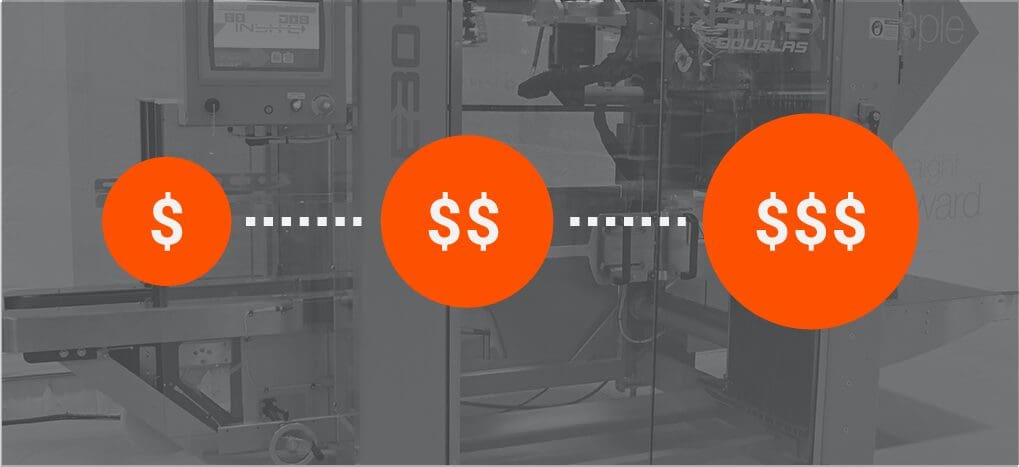
Typical Equipment Price Ranges (Contextual Only)
For equipment alone (excluding installation, integration, and system costs):
-
Entry-level fully automatic: ~$35k-$60k
-
Mid-range automatic with robust controls and forming: ~$60k-$120k
-
High-speed or highly specialized systems: ~$150k-$250k
These ranges vary based on customization level, regional build standards, controls philosophy, and how conservatively the machine is engineered for real-world duty—not just rated output.
Wide spread exists because design intent varies widely, even within the same automation tier.
conclusion
The Bottom Line
Fully automated case erectors don’t cost more because they’re “nicer machines.” They cost more because they shift risk.
Higher-priced systems move risk away from …
-
Operators making perfect adjustments
-
Maintenance reacting to wear and variability
-
Downstream equipment compensating for poor case geometry
And into …
-
Engineering
-
Controls architecture
-
Structural rigidity
-
Validated motion and safety systems
Lower-priced machines can absolutely work—but they assume more things will go right more often, and with more human intervention.
Once you see pricing this way, the question stops being “Why is this machine so expensive?” and becomes “Where do we want variability, intervention, and failure risk to live in our operation?”
Answering that question helps pricing differences make sense before you even start modeling ROI or total system cost.
Explore INSITE Solutions
Automation doesn’t have to be all-or-nothing. Learn more about INSITE’s modular approach.