Introduction
Are labor shortages, production bottlenecks, or safety concerns making it harder to keep up with customer demand?
Are you hesitant to automate because fully integrated systems feel too expensive, too rigid, or too risky for where your business is today?
Modular automation offers a middle ground.
Modular automation offers a middle ground. It allows you to gain many of the benefits of automation without committing to a large, all-at-once investment.
In this article, we’ll explore the challenges of fully manual and fully automated secondary packaging operations—and explain how modular automation provides a lower-risk, more flexible path forward.
The Challenges of Manual Secondary Packaging Operations
Manual secondary packaging is often where growing manufacturers start. But as demand increases, its limitations become harder to ignore.
Manual secondary packaging challenges:
Limited Throughput
Labor Availability
Safety Concerns
Opportunity Cost
How Manual Packaging Limits Throughput
Manual packaging slows production by requiring multiple hands-on steps for every unit shipped.
Workers must erect cases, pick and place products, seal packages, label them, and move finished goods to conveyors or storage. Each step adds time and increases the chance of errors, which ultimately limits how much product can move through your facility.
As order volumes grow, manual processes often become the primary bottleneck.
Why Labor Availability is a Growing Risk
Manual packaging depends heavily on consistent labor—and that’s increasingly hard to find.
High turnover and competition for workers can lead to fluctuating productivity and rising labor costs. When your operation relies almost entirely on people to package products, labor challenges have a direct and immediate impact on output.
Even short staffing gaps can disrupt your ability to meet customer expectations.
Safety Concerns in Manual Packaging Environments
Manual packaging exposes workers to repetitive motion, lifting, and injury risks.
Handling cases, bending, twisting, and repetitive movements increase the likelihood of strains, cuts, and long-term injuries. Beyond the human cost, workplace injuries can lead to higher insurance premiums, lost productivity, and regulatory scrutiny.
Reducing manual handling is often one of the strongest drivers toward automation.
When manual processes cap your output, you may be leaving revenue on the table.
If customer demand exceeds what your packaging operation can handle, you’re effectively limiting growth and leaving money on the table. Over time, this opportunity cost can outweigh the perceived savings of avoiding automation.
The Risks of Fully Automated Secondary Packaging Systems
While automation can solve many manual challenges, jumping straight to fully integrated systems introduces new risks—especially for growing or mid-sized operations.
Fully integrated & automated secondary packaging challenges:
Difficult to Achieve ROI
Reduced Flexibility
Increased Complexity
Space Constraints
Why ROI Can Be Difficult to Justify
Fully integrated automation often comes with a high upfront price tag.
Machines that erect, pack, and seal cases in a single system can cost hundreds of thousands of dollars. To justify that investment, many companies require a payback period of two to three years. For businesses still building volume or navigating demand uncertainty, achieving that return can be difficult.
How Fully Automated Systems Reduce Flexibility
Integrated machines are typically designed for very specific products and package formats.
If retailers request a new case size, pack configuration, or product variation, your equipment may not be able to adapt easily. Modifications can be expensive—or, in some cases, not feasible at all. This rigidity can limit your ability to respond to market changes.
Increased Complexity and Skill Requirements
The more functions a machine performs, the more complex it becomes to operate and maintain.
Fully automated systems often require specialized mechanical and electrical expertise. In today’s labor environment, those skills can be difficult to hire and retain. More complexity also means more downtime when issues arise.
Space Constraints on the Packaging Floor
Highly integrated automation systems often require a larger, fixed footprint.
Unlike manual stations or smaller machines, these systems can be difficult to fit into existing layouts. If space is limited, automation may force costly facility changes or expansions.
What Is Modular Automation in Secondary Packaging?
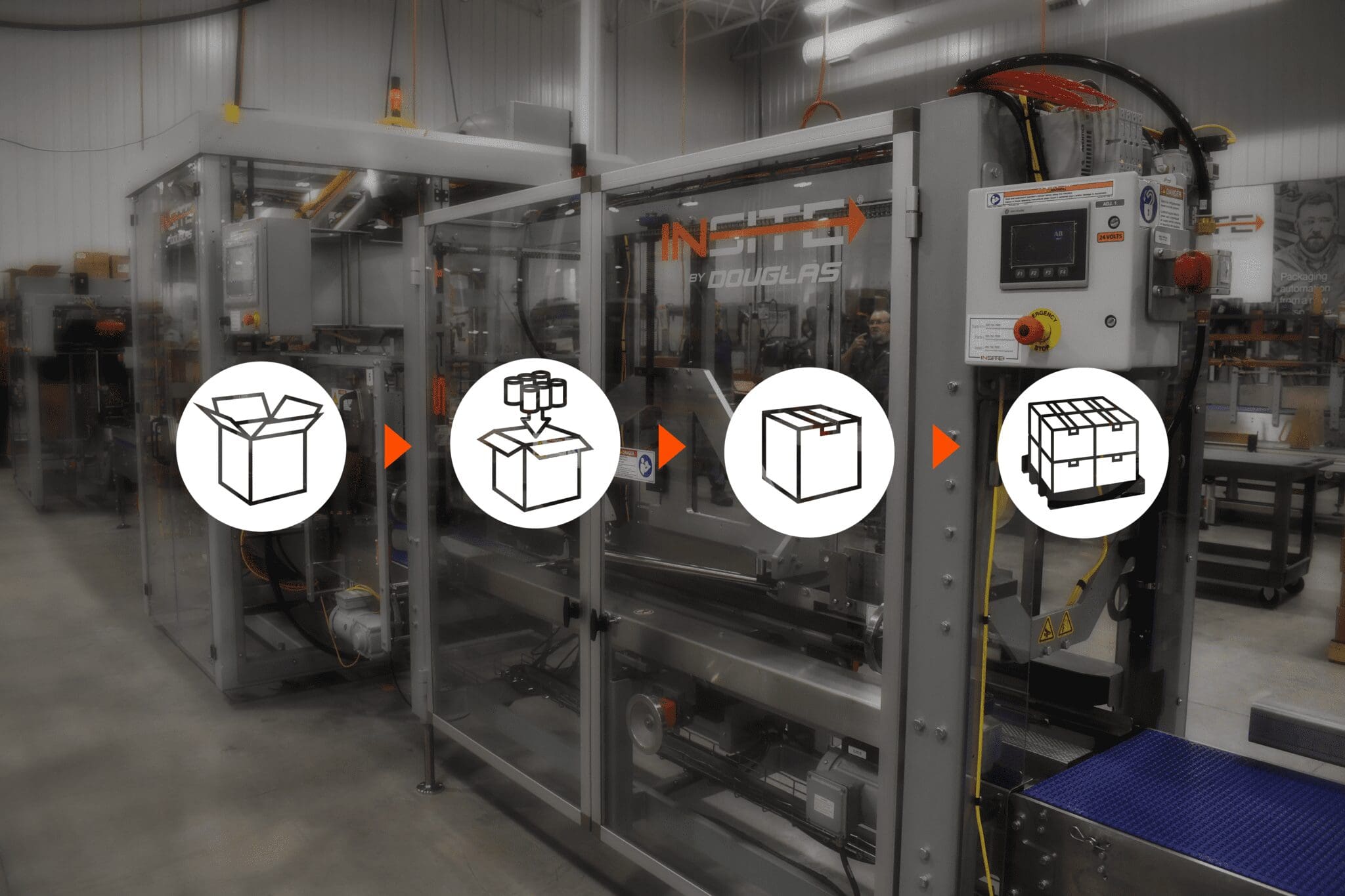
Modular automation breaks secondary packaging into individual, standalone functions—or modules.
Rather than automating everything at once, modular systems allow you to address specific tasks independently. Common modules include:

Case Erecting
Case Loading
Case Sealing
Palletizing
Each module can operate manually or be automated on its own timeline.
Why Modular Automation Strikes the Right Balance
Modular automation combines the benefits of automation with greater control over cost, complexity, and flexibility.
Automate Where It Hurts Most
With modular automation, you choose which bottleneck to solve first.
Instead of overhauling your entire line, you can target the area causing the most disruption—whether that’s case erecting, packing, or sealing—and automate only that function. This phased approach reduces financial risk while delivering immediate improvements.
Maintain Flexibility as Your Business Evolves
Modular systems can be rearranged, expanded, or upgraded over time.
Because each module performs a single task, it’s easier to adapt your layout, add capacity, or change configurations as needs evolve. Conveyors can link modules in ways that fit your available floor space.
Reduce Complexity and Improve Reliability
Single-function machines are simpler to operate and maintain.
By limiting each module to one task, you reduce training requirements, maintenance complexity, and downtime. This simplicity makes modular automation easier to support with in-house teams.
Lower Risk, Higher Confidence in ROI
Smaller, targeted investments are easier to justify and pay back.
By automating incrementally, you spread costs over time and validate returns at each step. This approach allows automation to grow alongside your business rather than outpacing it.
Summary
A Smarter Path Toward Packaging Automation
Now you know the trade-offs between manual, fully automated, and modular packaging. Manual systems limit throughput and increase labor risks, while full automation may feel out of reach for growing businesses.
Modular automation offers a practical, flexible path forward.
Modular automation offers a practical, flexible path forward. It allows you to target your biggest pain points first without over-committing.
Your next step is to explore how modular solutions can be phased into your line. Start with the area causing the most disruption and grow from there.
At Douglas, we help manufacturers build right-sized automation strategies that scale. We’re here to help you evolve your packaging operation at your pace, with confidence.