Introduction
If you’re not sure what a case erector will cost, you’re not alone.
Budgeting for a case erector can be surprisingly complex — especially if you’re moving from manual processes or upgrading a legacy system. From installation costs to changeovers and maintenance, there are hidden expenses that can quickly derail your ROI.
At INSITE, we’ve guided hundreds of manufacturers through this decision. Whether you’re scaling your line or improving efficiency, we help you avoid common pitfalls and make smarter investments.
In this article, you’ll learn how to budget for a case erector — including capital costs, installation, training, and long-term operating expenses — so you can plan confidently and avoid costly surprises.
What Factors Drive the Cost of a Case Erector?
Before you look at price ranges or ROI calculators, you need to understand what will drive the cost of your case erector. These four questions are the biggest determinants of what you’ll ultimately pay — and whether the investment delivers long-term value.
How Fast Does Your Line Need to Run?
Higher speed almost always means higher cost — not just for the machine itself, but for what it takes to sustain that speed over time.
What drives speed-related costs:
-
More robust mechanical designs
-
Tighter tolerances for forming and squaring
-
Bigger drives and motors, more controls
-
Feeding/picking systems that tolerate slight blank inconsistencies
Don’t budget for peak speed — budget for sustainable speed.
Many erectors can hit high rates briefly, but only high-quality machines can maintain that output shift after shift without added maintenance, wear or downtime.
Ask yourself: Do you need peak speed occasionally, or do you need consistent output every day? Paying for speed you rarely use can inflate capital costs unnecessarily, while under-specifying speed can create bottlenecks that limit line performance.
Pro Tip
To identify areas that slow down your line’s speed, check your machine’s data collection capabilities. Most prominent erectors should be able to use production data to pinpoint problematic SKUs or shifts.
How Does SKU Count Affect Your Case Erector Budget?
High SKU counts mean frequent changeovers — which can drive up both capital and downtime costs.
If your operation runs multiple box sizes, you need a system that can:
-
Add new SKU recipes quickly and easily (some legacy equipment can cost ~$10k for a new recipe)
-
Hold settings accurately between runs
-
Return to previous recipes without the need for re-tuning
-
Maintain case quality across SKUs
Machines with true recipe-driven or tool-less changeovers often cost more upfront but can easily pay off in saved downtime and reduced operator frustration.
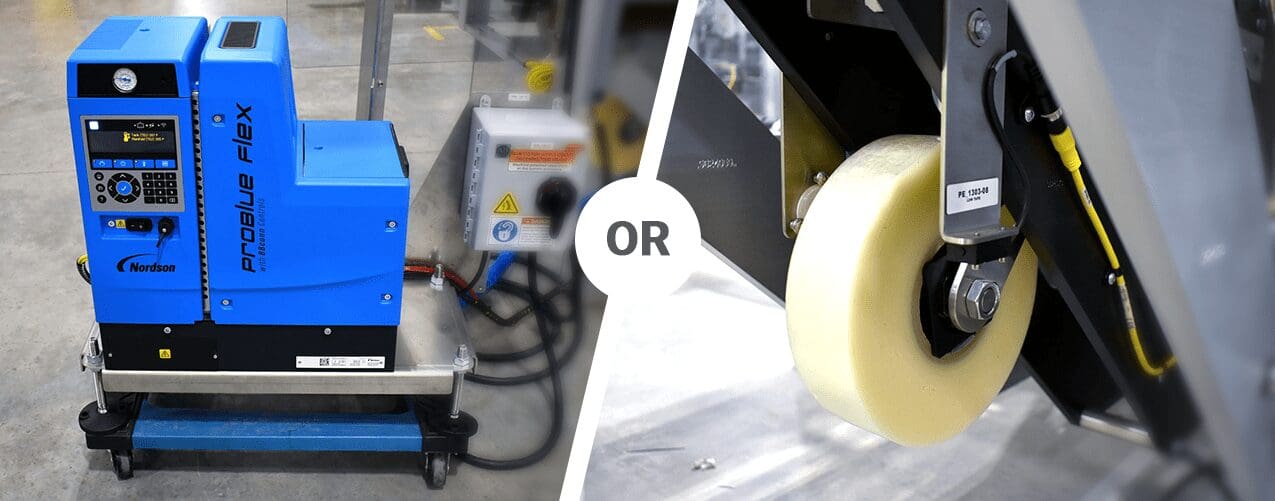
Should You Use Tape or Glue for Case Erecting?
Tape-based systems are cheaper upfront and easier to install, but glue systems may offer better performance in specific use cases.
Tape: Lower Cost, Lower Complexity
-
No need for glue tanks or heating components
-
Less to maintain
-
Ideal for low- to mid-speed operations
Glue: More Upfront Cost, More Capability
-
Less per unit cost
-
Possible material savings, less waste
-
Less downtime at fast speeds (glue tanks can be refilled while machine is running)
-
Cleaner appearance in some environments
-
Opportunity for more robust seal
Pro Tip
Choose tape for simplicity, but consider glue if you’re prioritizing speed, presentation, or downtime.
How Much Should You Invest in Build Quality?
There is absolutely a place for lower-cost case erectors — especially for simple applications, lower speeds, or short-term needs. However, it’s important to recognize where those savings often come from.
Lower upfront costs can translate into:
-
Increased adjustment and tuning
-
Higher maintenance frequency
-
Reduced uptime
-
Greater sensitivity to blank quality or environmental variation
Once a machine is on your factory floor, the cost of downtime, rework, and maintenance labor can quickly exceed the difference in purchase price.
Higher-quality, more robust machines typically cost more because they are designed to:
-
Improve usability and convenience for operators and maintenance staff
-
Hold adjustments over time
-
Run consistently across shifts and operators
-
Produce square, repeatable cases that downstream equipment can rely on
From a budgeting standpoint, investing more upfront in build quality often reduces total cost of ownership over the life of the machine — especially in multi-shift, high-throughput, or high-SKU environments.
How Much Does a Case Erector Cost? (Price Table)
What’s your starting point today? Your current process will influence which tier of automation you need and what budget to expect. Here are the three usual starting points:
-
Manual: 100% hand forming, packing, and sealing
-
Semi-Automated: Manual forming with assistive devices or bottom sealers
-
Fully Automated: You’re using a case erector but want to improve speed or uptime
Price Table by Automation Tier
The faster and more flexible the machine, the higher the initial investment — but the lower your per-case labor cost.
Level of Automation
Typical Speed / Cases Per Minute (CPM)
Approximate Capital Cost Range
Operator Owns
Approximate Labor Investment
100% Manual
Typical Speed / Cases Per Minute (CPM)
N/A – Too many variables
Approximate Capital Cost Range
$0
Operator Owns
Open, form flaps, and seal
Approximate Labor Investment
$0.15/case (1 person yields ~4 cases/min)
Semi-Automatic
(Bottom Seal Only)
Typical Speed / Cases Per Minute (CPM)
~10-12 CPM
Approximate Capital Cost Range
$5K-$15K
Operator Owns
Open and form flaps
Approximate Labor Investment
~2 people to maintain this rate
Semi-Automatic (Bottom Form + Seal)
Typical Speed / Cases Per Minute (CPM)
~10-15 CPM
Approximate Capital Cost Range
$10K-$20K
Operator Owns
Open and place
Approximate Labor Investment
~1 person to maintain this rate
Fully Automatic (Bottom Tier)
Typical Speed / Cases Per Minute (CPM)
10-15 CPM
Approximate Capital Cost Range
$30K-$60K
Operator Owns
Magazine loading
Approximate Labor Investment
~.09 people to maintain this rate
Fully Automatic (Mid Tier)
Typical Speed / Cases Per Minute (CPM)
15-25+ CPM
Approximate Capital Cost Range
$60K-$90K
Operator Owns
Magazine loading
Approximate Labor Investment
~.17 people to maintain this rate
Fully Automatic (Top Tier)
Typical Speed / Cases Per Minute (CPM)
25-45+ CPM
Approximate Capital Cost Range
$90K-$150K+
Operator Owns
Magazine loading
Approximate Labor Investment
~.25 people to maintain this rate
Note: Manual estimates assume 15 seconds to open, form and seal a case. Semi-auto bottom seal assumes 10 seconds to open and form. Semi-auto bottom form and seal assumes 5 seconds of labor. Fully automatic estimates assume 97% efficiency, a 4-foot magazine, 60-second magazine refill time, and $35/hour labor rate.
What Budget Items Are Often Overlooked (or Underappreciated)?
Material Quality and Consistency
Hand-pack materials often have wider tolerances that automated equipment won’t tolerate.
Inconsistent case dimensions or poor corrugate quality can cause jams, misfeeds, and slow startups.
Work with your supplier early to tighten specs or adjust materials for automation—it can streamline commissioning and reduce downtime.
Installation
Even self-installable case erectors require coordination with your existing line controls, electrical service, and air systems. On average, expect OEM installations to cost ~$10–12K.
Rigging alone can cost a few thousand dollars depending on location and plant restrictions.
Be sure to budget for integration with upstream and downstream conveyors, PLCs, and safety interlocks.
Failure to account for these integration points can delay deployment and add cost.
Training

Some systems are easier to learn than others. Machines with excessive parts, complex motion paths and multiple hand-offs can extend training time and delay startup.
Training is often available from the OEM, but may come at an added cost—ranging from a few hours to several days depending on your line’s complexity.
Tool-less changeovers, intuitive HMIs, and open designs typically reduce both the learning curve and operator error.
Fewer moving parts and better access also make it easier for your maintenance team to get up to speed quickly.
Maintenance and Operating Costs
Labor, power, air, consumables (like tape or glue), wear parts and preventive maintenance needs all contribute to long-term operating costs.
Generally, the more components and parts an erector has, the more demanding it is to access and maintain—making it more costly to support over time.
Servo-driven machines with fewer mechanical wear parts often require 30% less maintenance time than pneumatic-heavy systems. Also consider average air usage (e.g., 4–10 CFM) and power draw when estimating utility costs. Compressed air costs can vary, but usage is a reliable indicator of long-term operating expense. Traditional case erectors often consume more than 20 SCFM, while optimized systems (like INSITE) can use as little as ~5 SCFM—up to 4x less air per cycle. That efficiency translates directly to lower utility costs over time.
Floor Space
While automation can reduce the labor required to form and erect cases, your equipment still occupies floor space.
Typical case erectors range from 10–15 feet long and 4–6 feet wide. Be sure to weigh that against the case size range the machine supports. Systems like INSITE offer a broad size range in a compact footprint, maximizing capability without consuming excess space.
But don’t forget to account for safety clearance zones, refill access, and operator movement—these can add 25–30% to your actual layout requirement.
Be sure to consider line flow, operator access, and whether you’ll use an inline or right-angle configuration.
Changeover Costs
If you’re running a high number of SKUs budget for changeover downtime unless your erector is optimized for fast, repeatable transitions.
Manual changeovers on lesser erectors can take 10–20 minutes with additional time for ‘tuning’, while tool-less or recipe-driven systems can cut the overall time to 5 minutes or less.
In high-mix operations, simple and smartly designed erectors with quick-change features can recover a meaningful amount of uptime per week, per line—making this a key ROI driver.
conclusion
What Should You Do Next?
At the end of the day, budgeting for automation can feel overwhelming — especially if you’ve never purchased a case erector before or are moving up from manual processes.
Now that you know what drives cost — from speed and SKU count to training, changeovers, and integration — you’re in a strong position to define your requirements and choose the best-fit solution.
If you feel INSITE may be a good fit for automating your case erecting, please reach out to us and ask questions.
Explore INSITE Solutions
Automation doesn’t have to be all-or-nothing. Learn more about INSITE’s modular approach.