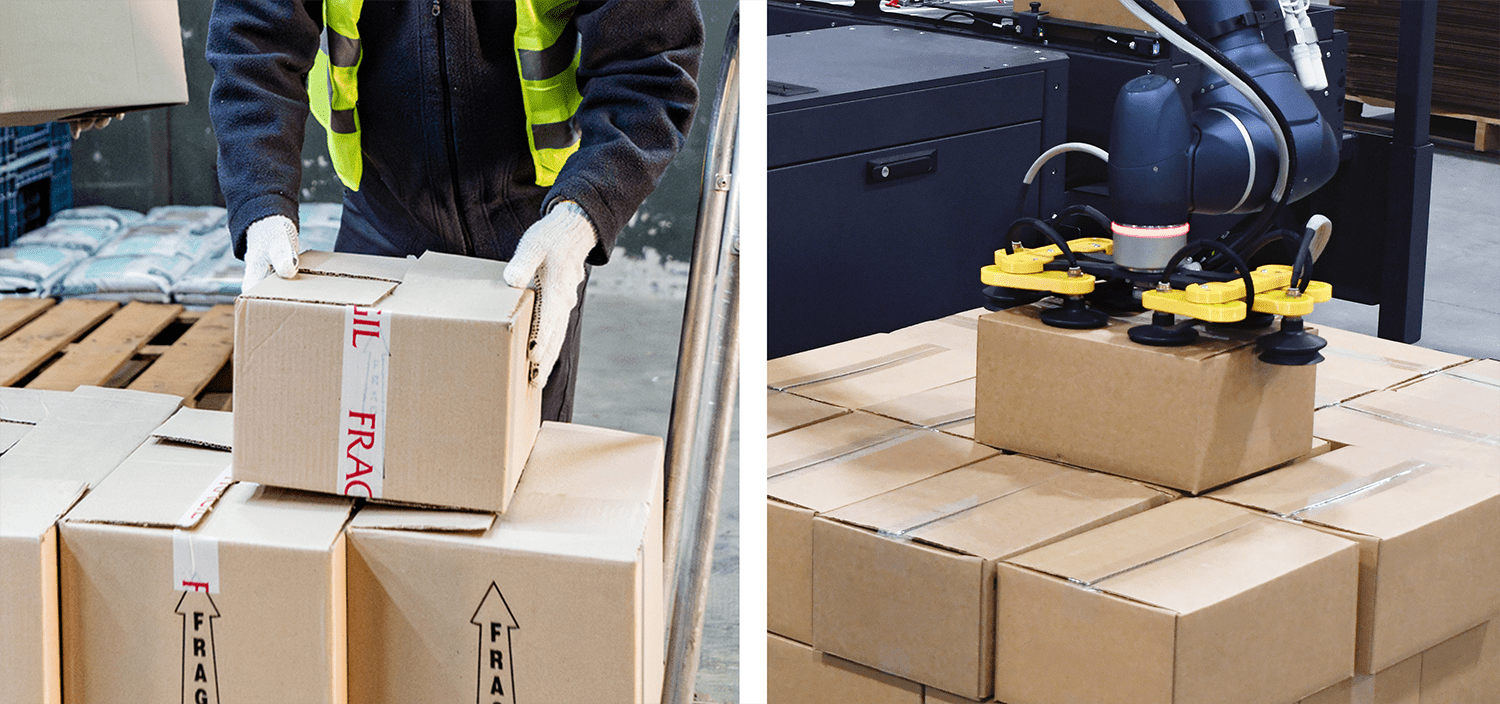
Introduction
At a Glance
The right choice of whether to stay manual vs. automate your secondary packaging line, is entirely case-dependent. There isn’t a ‘one size fits all’ answer. However, there are some general signs that may point to one route or another:
Stay Manual If You Have…
- Low Volume
- Frequent Format Changes
- Limited Available Capital
Automate If You Have…
- Labor Cost and Staffing Issues
- High Injury Rates
- Missed Targets
If it is time to automate, a natural first step may be to target the highest risk aspect of your line: often case erecting or palletizing. And if you’re still unsure because of ROI concerns, take heart, knowing that most operations see a return in 18-36 months.
Any vendor who tells you automation is always the right answer, is probably working for the sell. Automation is never free, and your operation should justify the cost before you take the first steps.
However, many CPG operations do see great benefits from automating. Oftentimes, it’s less a question of whether to automate, and more a question of which step to automate first. The modular approach is often a good choice – but how to know when timing is right, and where to start?
In this article, we’ll cover:
- Cases where manual vs. automated is the right path
- How to take your first steps toward automation
- Which end-of-line step to automate first
- How to know if your capital investment will pay off
Operations That Make the Case for Manual
The choice to automate your packaging line is entirely a case-by-case, operational decision. Not every operation should automate – there are scenarios where the wiser move is to stay manual.
This can be especially true when:
- Volume Is Low – If your operation is running fewer than 100 cases per shift, automation can end up being a liability. Manual is likely the more cost-effective decision.
- Formats Change Frequently – If you have a highly-variable, short-run operation, automation may prove especially costly for you. The wider the SKU-mix a machine needs to accommodate, the more it’s going to drive up price and complexity.
- Capital Is Limited – Manual operations will always be the cheaper route. If capital is tight, it may be wise to save money for a higher-quality machine later.
These situations don’t mean that you have to stay manual forever; they just indicate that right now, it’s not the time to automate. If one or more apply to your operation, manual is likely the wiser decision – for your budget and team.
Signs It’s Time to Automate Your End-of-Line
Sometimes the choice to automate is one made out of preference – a team decision to upgrade the operation. But oftentimes, there are a few indicators that manual operations are becoming costly, and that automation is the way to go.
Here are some of the most common signs:
Labor Cost Is High – A significant portion of your line budget is going to labor costs. It should especially raise red flags if labor costs are a growing issue for your operation.
Staffing Issues – You consistently struggle with staffing end-of-line positions, especially for physically demanding tasks (e.g. case erecting or palletizing).
Injury Rates – Injuries or near-misses are more frequently occurring at end-of-line workstations – most commonly with case erecting or palletizing.
Missed Targets – Throughput targets are being missed, because your end-of-line has become the bottleneck.
Note: If you are missing your throughput targets for another reason (e.g. unrealistic goals, etc.), then automating your end-of-line isn’t necessarily the solution.
Inconsistent Quality – Case or pallet quality is inconsistent; poorly erected cases or unstable pallets are creating damage or compliance issues.
These problems aren’t surefire proofs that your manual end-of-line is the liability. Always make sure you properly evaluate where the problems originate. However, if one or more are true of your operation, automated equipment may prove effective. It could be time to automate.
How to Take Your First Steps Toward Automation
You don’t have to automate your whole line all at once. In fact, if it’s your first time automating, it’s likely the wiser decision to take a modular approach. This means purchasing one or two machines at a time, eventually moving toward a fully automated line.
For most operations, the highest-value starting point is the step that is causing the greatest liability. Is there a point in your line that’s driving your labor burden, injuries, or throughput constraints?
The two we see most often are:
Case Erecting
A case erector may be the right choice, especially if you are a high-volume, single-SKU operation. In these environments, we often see manual case erecting falling behind the rest of the line’s capabilities.
Palletizing
For most other operations, a palletizer is probably the way to go. Physically demanding, highly repetitive, and easy to automate without great disruption, palletizing is often a safe choice.
Note: If you’re interested in modular, take a look at INSITE’s line. Our machines are designed to be built onto each other, accommodating a modular approach.
What ROI Actually Looks Like
One of the biggest questions for operations starting to automate, is that of return on investment (ROI): “How do I know automation is worth it?”
For most mid-volume, CPG operations, automation tends to pay back in 18-36 months. The big factor here is displaced labor – when you don’t have to pay operators to work directly on one task, you see the capital investment start to pay off.
Your actual ROI will depend on things like labor rates, shift structures, volume, and equipment cost. Like everything in secondary packaging, the answer depends on your operational specifics. But if you want to tackle automation ROI, you’ll want to start by looking at these four areas.
The Easiest Route: Collaboration with a Vendor
If automation has been weighing on your mind, the best course of action is probably to just set up a call. A good vendor should work with you to evaluate whether automation is a valuable decision for your operation. And they’ll probably have a pretty good suggestion as to where to start.
Don’t see a vendor meeting as a contract – see it as an opportunity to discover where your growth lies.
Wondering Whether You Should Automate?
Give INSITE a call. Our team of specialists will answer questions, collaborate with you to evaluate your system, and explore the possibility of automation.